


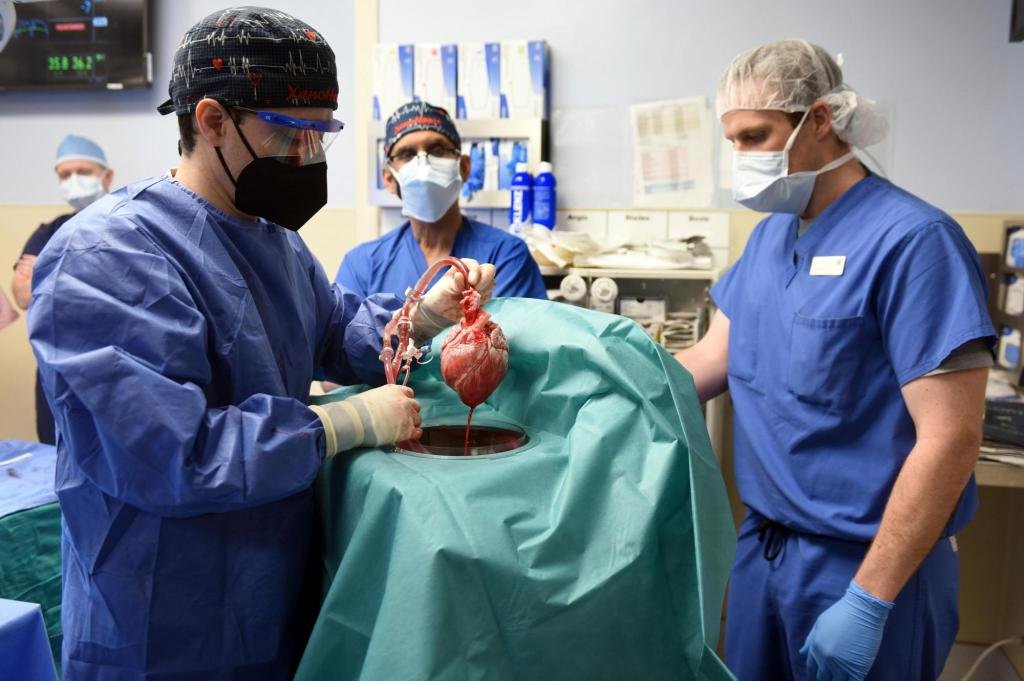

Last year, there were 48,149 organ transplant procedures in the United States, or roughly 132 kidneys, livers, hearts, lungs and other organs transplanted every day — a new record. Each day, 13 people died on the nation’s transplant list, waiting. It is a list now 103,000 names long.
Apart from the enduring challenges of getting a donor organ to the right recipient in a timely, efficient and fair manner, there has long been the problem that a lot of potential donor organs go unused, often because they are only marginally healthy or they would not fare well in the process of transport or transplantation.
But new therapies, such as perfusing donor organs, are changing the equation and increasing the supply. Not so long ago, getting an organ from donor to recipient meant packing it in an ice-filled cooler and transporting as quickly as possible. Perfusing donor organs with blood and other fluids while in transit lessens the possibility of tissue injury, inhibits damaging immune responses and maintains cellular homeostasis or equilibrium. In some cases, it even improves the quality of the organ.
Still, there will never be enough human donors. While 95% of Americans say they support organ donation, less than 60% actually register and just 5% ultimately become donors.
To better meet demand, scientists are looking to other animal sources (xenotransplantation), specifically pigs, whose organs are similar in size and function to humans and who present a relatively low risk of transmitting diseases to people compared to other species.
Of course, humans aren’t pigs. There are immunological challenges. Pigs possess proteins and genes sufficiently different from humans to trigger rejection. But gene editing and other technologies are making pigs a better source of usable whole organs. They’re already widely used for other transplantable tissues, such as heart valves.
The world’s first successful transplant of a genetically modified pig kidney happened last year. The 62-year-old U.S. man, dying of end-stage kidney disease, fared well. The kidney functioned. The man died two months after the procedure, not from kidney failure but rather an “unexpected cardiac event.”
Earlier this year, the U.S. Food and Drug Administration approved the first clinical trials to assess the safety and efficacy of transplanting kidneys from genetically modified pigs into people with kidney failure. Donor kidneys are by far the greatest need: More than 80,000 people on the national waiting list are waiting for a kidney.
There are, of course, serious ethical questions to address when it comes to creating animal organ donors. The idea prompts a degree of squeamishness. Why not instead build replacement human organs from scratch?
The idea has been seriously percolating since scientists learned how to reprogram stem cells to become almost any type of cell needed. They can now build “organoids” — three-dimensional, self-organizing structures that mimic the human brain, intestine, liver, lung, retina, heart and pancreas. These organoids are able to reproduce many organ functions. Researchers have grown brain organoids that produce electrical patterns resembling those of premature babies and heart organoids with beating cells.
But organoids are not organs. They are very small, ranging in size from a sharp pencil point to a new pencil eraser. They currently capture just a fraction of the scope and performance of full-sized, fully functioning organs, whose physiological structures are quite complex and present other significant hurdles still to be overcome.
And there are complex ethical issues to consider, including commodification of the human body, equitable access to new technologies and what it means to be the recipient of a bio-artificial organ.
But these issues will be resolved because more viable donor organs, whether from humans, other species or created in a lab, means fewer people will be fated to sit (and perhaps die) on a transplant waiting list.
Brenner is a physician-scientist and president and chief executive officer of Sanford Burnham Prebys and lives in La Jolla.