


By Coral Murphy Marcos
The New York Times
Bad Bunny’s sold-out 30-show residency in Puerto Rico, titled “No Me Quiero Ir de Aquí” (“I Don’t Want to Leave Here”), earlier this month entered its second phase, which is open to fans who aren’t residents of the territory. The star’s music casts Puerto Rico as more than a playground for tourists chasing beaches and winter escapes.
The concerts at the Coliseo de Puerto Rico José Miguel Agrelot in San Juan, following the release of his album “Debí Tirar Más Fotos” in January, unfold in the middle of hurricane season and end in September, the same month Puerto Rico was hammered by Hurricane Maria in 2017. The devastation wreaked by the storm had a lasting impact on Bad Bunny, who was raised in Vega Baja, and he has since used his global platform to spotlight the archipelago’s struggles, from chronic blackouts to the displacement of locals amid tax breaks for wealthy investors.
His criticism has even zeroed in on tourism in Puerto Rico: His song “Turista” uses a short-lived dalliance as a metaphor for thoughtless visitors.

“Tourists come to places like Puerto Rico, enjoy themselves for a little while, see the best landscapes, the best sunsets, do a bit of dancing, eat some good food,” he said in a radio interview. “Then they leave, and they don’t find out about, or don’t have to deal with, the problems the country is going through.”
In that vein, here are some ways to dig deeper into Puerto Rico’s culture and history for those going to see his shows (or who just wish they could):
A different view of Old San Juan
In Old San Juan, the capital’s historic colonial district, Memoria (De)Colonial offers alternative walking tours through the centuries-old city. Unlike typical tours that focus simply on the beauty of the architecture and cobblestone streets, these walks delve into the place’s complex colonial history, from Spain’s rule to Puerto Rico’s current status as an unincorporated territory of the United States.
The tour also explores how Old San Juan has changed in recent years, especially since shifting tax policies have fueled gentrification. Bad Bunny’s lyrics have long captured the anger felt by locals over how rising housing costs have pushed many to leave Puerto Rico.

“I share anecdotes from students about how they were displaced from their apartments along with their families,” said Sofía Martínez Rivera, 25, coordinator of the (De)Tour project, which manages Memoria (De)Colonial’s walking tours. “With visitors, it’s always a moment of reflection on how they travel.”
-
A tour guide holds up historical photographs during Memoria (De)Colonial’s walking tour of Old San Juan, Puerto Rico. The tour explores the complex colonial history of the place. (Erika P. Rodríguez / The New York Times)


1 of 3
A tour guide holds up historical photographs during Memoria (De)Colonial’s walking tour of Old San Juan, Puerto Rico. The tour explores the complex colonial history of the place. (Erika P. Rodríguez / The New York Times)
In late July, new tours began for concertgoers: Fridays in English and Saturdays in Spanish.
The rhythms of bomba and plena
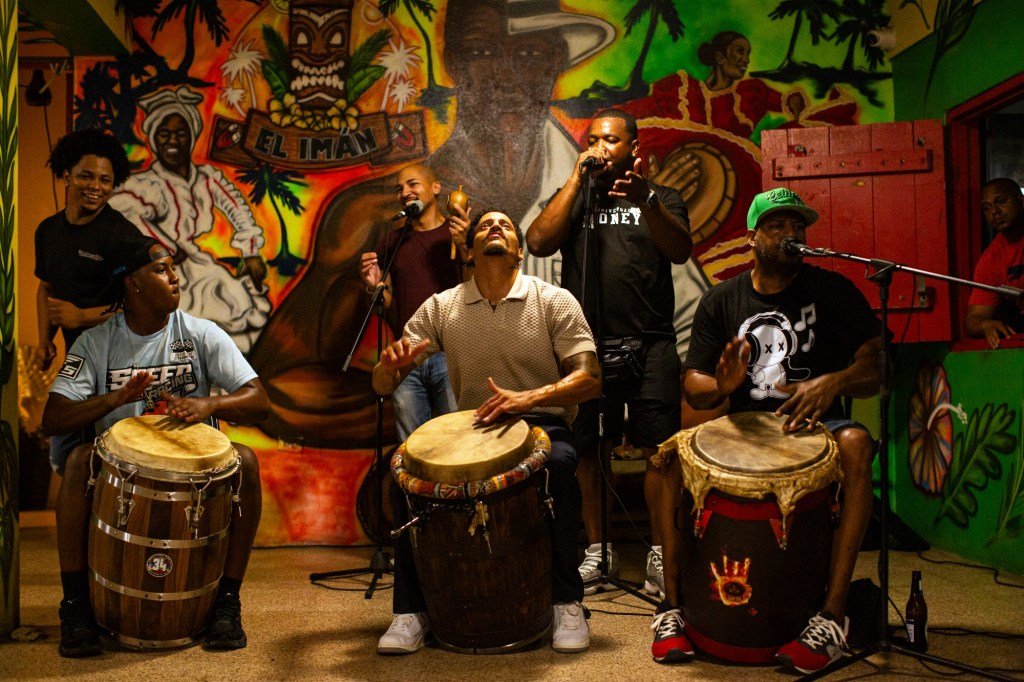
The seaside restaurant El Imán sits among the roadside shacks of the Piñones area in Loíza, about a 10-minute drive from the San Juan airport. The restaurant hosts live performances of the folkloric Puerto Rican music known as bomba, usually on Thursdays and Sundays.
Bad Bunny blends reggaeton with bomba, first danced by enslaved Africans in Puerto Rico centuries ago, and the music remains a powerful form of political and spiritual expression. Loíza, settled by Yoruba people from West Africa in the 16th century, reflects this heritage through its music, food and traditions.

Through mid-September, bomba workshops take place every Sunday at the Ismael Rivera Foundation, a small museum in San Juan’s Santurce neighborhood dedicated to one of Puerto Rico’s most beloved musicians. Tours are available with advance notice.

A 10-minute walk away, La Casa de la Plena Tito Matos honors the late master of the requinto drum and plena, another folkloric musical genre once dismissed by elites but beloved by working-class and Black Puerto Ricans. Plena became known as “el periódico cantado” (the sung newspaper) because its songs told everyday stories. Inside, visitors can view an archive of videos, writings and photos that belonged to historian and cultural anthropologist Ramón López, who elevated popular Puerto Rican culture and questioned colonial narratives.
Casa Pueblo
Power disruptions remain a concern across Puerto Rico, an issue compounded by natural disasters and the privatization of the electrical grid. The title of Bad Bunny’s 2022 song “El Apagón” means “blackout,” and its video included an 18-minute documentary about inequities that many say compound the problem.
But in the mountain town of Adjuntas, a nonprofit offers an example of a self‑powered future.

Casa Pueblo, founded by environmental activist Alexis Massol González and his wife, Tinti Deyá Díaz, has become a model for energy independence. One of their sons, Arturo Massol Deyá, now runs the organization, which has helped expand solar adoption across the archipelago, especially since Hurricane Maria.
In 2023, Adjuntas launched Puerto Rico’s first community-owned solar microgrid. The town has five microgrids that power 15 local businesses and dozens of homes.
Casa Pueblo’s Energy Independence Plaza features an open-air community center and a “solar forest” made up of tall fixtures shaped like trees with solar panel branches. The community space offers steady, renewable electricity to nearby homes and businesses. A separate battery bank is open to the public for charging phones or powering devices when the rest of the island loses power.

Lares
Lares, a coffee-growing town about an hour’s drive from Adjuntas, was the site of a rebellion against Spanish rule in September 1868 that is commemorated today as El Grito de Lares. The Spanish quickly crushed the uprising, but the protest against political and economic oppression crystallized Puerto Ricans’ claims for self-rule. Bad Bunny’s song “Turista” was released with a companion video that shows text explaining the history and significance of that revolt.

At Plaza de la Revolución, visitors can see a bust of Ramón Emeterio Betances, one of the uprising’s leaders and the designer of the Lares flag, which flies in this region just as frequently as the Puerto Rican flag. Bad Bunny frequently displays a version of the Puerto Rican flag that uses a lighter shade of blue than the government standard — a nod to the Lares flag’s blue and a widely recognized symbol of the independence movement.
The town is dotted with murals of figures like Pedro Albizu Campos, the independence movement’s most popular leader, who spent over 20 years in prison for organizing against U.S. rule.
And no visit to Lares is complete without a stop at one of its famous ice cream shops. Heladería Lares offers unconventional flavors like rice and beans or garlic.

Museo de Nuestros Mártires
Tucked in the central mountains of Jayuya, Ernesto Dávila Marín welcomes anyone to the Museo de Nuestros Mártires, a museum inside his home honoring those who have fought for justice and sovereignty. Bad Bunny pays tribute to that effort throughout his oeuvre, for example in his song “La Mudanza,” with the lines: “Aquí mataron gente por sacar la bandera, por eso es que ahora yo la llevo donde quiera” (“They killed people for showing the flag here, that’s why I now take it everywhere”).

Dávila Marín, whose family lived through the 1950 Jayuya Uprising, a revolt for independence from the United States, opened the museum 25 years ago. It features photographs and artifacts that document Puerto Rico’s struggle for independence and civil rights, including the criminalization of its flag in the 1940s and ’50s and a 1978 police ambush that killed two young independence activists.

“I lived in the United States for 36 years and when I came back, I realized how unfair we’ve been to our heroes and our martyrs,” Dávila Marín said.
Salsa in San Juan
Plaza de los Salseros in Santurce’s Villa Palmeras sector pays tribute to Puerto Rico’s salsa icons, from Héctor Lavoe to Choco Orta, the first woman to be honored there, and celebrates the music that inspired Bad Bunny’s “Baile Inolvidable,” which the Times in June selected as one of the best songs of the year.
If a salsa lesson is on your bucket list, Eco’s Sports Park, a laid-back social club and sports complex, offers beginner-friendly classes on Tuesday nights. Once class ends, a live salsa band kicks off, the dance floor opens up to everyone and you can practice your moves.
