


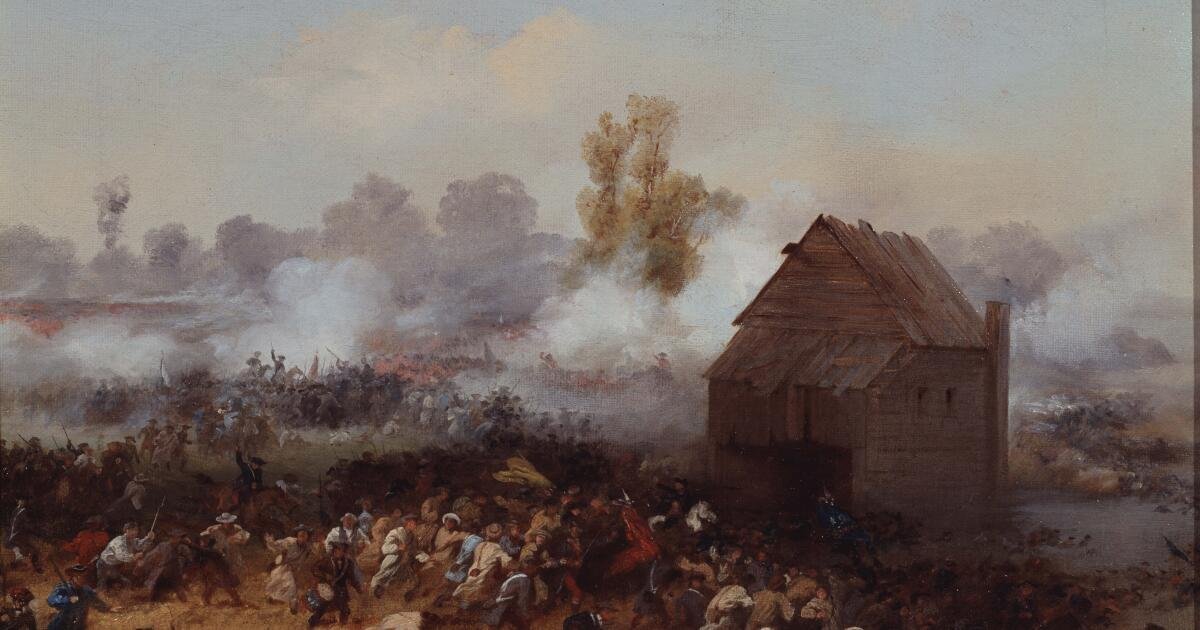
What do you think you know about the American Revolution?
Nearly 250 years later, as we continue to debate what the Founders intended, we may find at times that we’ve been led astray by legend, hornswoggled by hand-me-down history. What we thought we knew and what we didn’t know can be surprising, as a new PBS documentary series reveals.
The conflict was so brutal, broad and complex that it strongly motivated Indigenous people and those who would come to be known as African Americans to fight on both sides. It turns out Benedict Arnold was a certified badass for America. And George Washington, the biggest star of this momentous drama, was something of a bungler whose teeth were not wooden and who conducted a campaign to destroy Indigenous food stores.
“George Washington is flawed, makes bad military decisions, but without him, we don’t have a country,” says multi-Emmy and Peabody Award winner Ken Burns, one of the three directors of the six-part docuseries “The American Revolution,” premiering Sunday on PBS. The show doesn’t reject the “Great Man” school of history so much as it converts it to a “Great Men Don’t Win Championships; Great Teams Do” approach.

“George Washington” by Charles Willson Peale. “George Washington is flawed, makes bad military decisions, but without him, we don’t have a country,” says Ken Burns, one of three directors of “The American Revolution.”
(Metropolitan Museum of Art)
“To use the baseball analogy,” explains Burns, “Babe Ruth only comes up once every nine times at bat and he also strikes out a lot. That also means that any given moment, [the important thing] might fall to a middle infielder who’s batting eighth or ninth. So, we have a bottom-up story that engages the wide variety of people that inhabit these 13 colonies. It’s not just the highlight reel, which is unfortunately all we [usually] play of the revolution; this is all of the people who [get on base] and all the people who hit into inning ending double plays.”
If there’s a main character, it’s Washington. He receives his due — at times, veneration — for the luminous courage that held together a loose coalition of colonies against the world’s foremost military power. But the series also covers the star’s strikeouts, and not just on the battlefield.
“George Washington invested in Western land, sent armies into Indian country” to help clear it of Indigenous people for settlement and profit, “owned a plantation that enslaved hundreds of people … it would be a miscarriage of history to leave that out,” says director David P. Schmidt.
Schmidt and fellow director Sarah Botstein cite examples of how the simplest practical considerations affected the prosecution of the war — weather, the importance of waterways, delays in relaying information — as details that made them rethink their ideas.
“The American Revolution is wrapped in a lot of mythology and nostalgia rather than, ‘OK, this is a super-complicated, deeply bloody, global war that was really unlikely that we were going to win and it took a long time,’” Botstein says. “It’s a war of big ideas. It’s a revolution, it’s a world war and it’s a brutal, ugly, vicious, 18th century war.”
Not your father’s revolution
The directors and writer Geoffrey C. Ward have assembled an impressively multi-dimensional examination of that period, with detailed breakdowns of key battles, thoughts from people of the time captured in primary documents, and surprising perspectives that deepen our understanding. While they had no survivors to interview or photographs to display, they spoke with prominent historians and had the help of a staggering cast. Dozens of well-known actors provide voiceovers, including Meryl Streep, Tom Hanks, Samuel L. Jackson, Morgan Freeman, Josh Brolin (as Washington) and Paul Giamatti as John Adams, years after his Emmy-winning turn on the HBO miniseries in which he played the second president.
Burns says that was all part of figuring out “how to loosen the barnacles of sentimentality that have encrusted themselves” on the war.
“Understand that democracy was not the original intention of it; it was a consequence of it,” he says.

The documentary directed by David Schmidt, left, Sarah Botstein and Ken Burns features interviews with prominent historians and voiceovers from several well-known actors.
(Stephanie Berger)
Ward understands the agita some might experience when thinking about that time; he had shared it. “It seemed to be a bunch of people in wigs doing things that didn’t have any connection to us. And this, for me, was a huge learning process just to realize how stupid we had been about that,” he says.
Save for Lin-Manuel Miranda’s cultural-phenomenon musical “Hamilton,” which made Revolutionary War figures vibrant in the minds of millions, that time period is distant enough that it can be difficult to relate to, even though it’s information Americans are required to learn in school (as Thomas Jefferson and other Founders believed an educated citizenry was essential to a functioning republic).
As one scholar puts it, the American Revolution started as a defense of property owners’ rights and ended up being fought by the poorest people in America.
“It’s important for people to understand it was not fought and won by ‘people in wigs,’ ” says Ward. “Actually, it was fought by absolutely ordinary people who had very little, who did not know what they would gain from it.”
Botstein says the exploration of war has to involve leaders and people on the ground who are affected by leaders’ decisions. “Hopefully, [the viewer is] thinking about the dynamics of leadership and the cost and the consequence to the people living through the war,” she said. “We want people to find themselves in the history somehow … ‘When did my family get here?’ ‘What does the American Revolution have to do with me?’ I usually use the phrase ‘braided narratives,’ that we’re constantly wanting the story to feel braided.”
By way of identifying some of the many strands in that braid, she rattles off figures who are probably lesser-known or previously unknown to viewers, including regular citizens and Native American leaders, along with now-famous ones such as the Marquis de Lafayette, saying each played their part.

A portrait of John Greenwood painted by John Ramage in 1785.
(The New York Academy of Medicine Library)
“We follow a wonderfully outspoken, profane, absolutely ordinary, but very eloquent guy who fights the war as a very young man, named John Greenwood,” says Ward, describing him as something of a Revolutionary War Forrest Gump, though more intelligent. After surviving some of the war’s most consequential battles, Greenwood goes home and then he becomes a privateer, Ward says. “He is captured, I cannot remember now how many times — five times, four times? And somehow, although he fails at everything after the war, he becomes New York’s leading dentist and pulls George Washington’s last teeth, a tooth which he wore on his watch fob for the rest of his life, proudly.”
“And they’re not wooden teeth that he’s replacing them with,” adds Burns. “It’s ivory from a hippopotamus.”
Deeper and more dimensional
“The American Revolution” doesn’t just correct apocryphal errors and present fascinating blow-by-blows of key battles; it provides more dimension to major motivations and important incidents. The British Empire didn’t want to hold on to its American colonies just for their resources and taxes; they represented its most rapidly growing market. While the Patriots, colonists seeking an independent America, rhapsodized about freedom, the British actually offered it to enslaved Black people, successfully recruiting many to fight for the Loyalists, colonists seeking to remain British subjects.
Burns invokes the Patriots dumping British tea into Boston Harbor, garbed in approximations of Indian dress mixed with their usual clothing. Whereas it’s often taught this was to hide their identities, perhaps even to frame local tribes, Burns refers to another of the many scholars’ insights: “It’s to claim aboriginal status. ‘We are no longer part of the mother country; we are different.’ ”
He notes the irony that the colonists would then spend 150 years “dispossessing [Native Americans] of the rest of the continent, but what do we feel right now, when we make a statement — the biggest act of protest up to this point? We dress like Native Americans because, guess what? We’re thinking we’re more American than we are British. It’s a huge moment.”

“Thayendanegea (Joseph Brant)” by George Romney. The Mohawk leader fought on the side of the Loyalists.
(National Gallery of Canada)
The Native Americans, meanwhile, were hardly monolithic. Some fought on the side of the Patriots and some with the Loyalists, and were key players in the conflict.
“We say at the very beginning that this is a bloody struggle that would engage more than two dozen nations, European as well as Native American nations,” says Burns. “A tribe like the Shawnee or the Oneida [had] its own foreign policy and was as distinct from each other as anybody. So you can’t say ‘they’ and mean ‘all Native Americans.’ They’re as distinct as the French are from the Belgians or the Dutch.”
Beyond nations, there were also varying groups and interests, including enslaved and free Black Americans, and women, too.
“Women, half the population, are active throughout the revolution, keep the resistance movement alive, are there at every battlefield, watching, helping, sometimes fighting,” he says.
The miniseries reminds us this was also a civil war, pitting neighbors against each other, and sometimes even family members. The show relates the story of John Peters, a Loyalist from Vermont, who meets a childhood friend in battle, and kills him.
“Benjamin Franklin’s own son is one of the most prominent Loyalists,” Ward adds. “Everybody’s family is totally torn apart by this, and not just within the colonial communities, but in Indian country. The formerly united Six Nations are torn apart by this war.”
Resonances and rhymes
Everyone involved is careful to point out that any resonance with today’s headlines is purely coincidental because the project took about 10 years to complete.
“People are always surprised how long ago those interviews took place because the historians are saying things that seem like we interviewed them yesterday,” Botstein says.
“There’s a wife of a German general who delays coming over to the United States, and she’s anxious because she hears that Americans eat cats,” says Burns. “There’s a failed invasion of Canada to make it our 14th state. There is a continent-wide pandemic with arguments about inoculation.” (Washington’s chancey decision to inoculate his troops against smallpox is regarded now as a strategic triumph.)
“This is what a study of history provides you with. Mark Twain is supposed to have said it doesn’t repeat itself, which it never does, but it rhymes,” says Burns. “Human nature doesn’t change. The study of history actually arms you with the best defense you could have, which is [understanding] what human nature is about, across time. The same people are there, same really good people, same really bad people, sometimes good and bad people in one, like a Benedict Arnold, who’s the fightin’-est general that Washington has … until he isn’t.”
Viewers may be surprised to learn just how daring and successful a Patriot military leader Arnold was before his decision to switch sides made his name synonymous with disloyalty. Some may question what the value is in looking at history through such a fine lens that it reveals its subjects’ blemishes.
“Human beings are flawed,” Ward says. “So were they. If we don’t accept that these people who did incredible and heroic and timeless things were also human beings, we can’t fix anything. They did heroic things, but they were gullible, self-obsessed, all the things we are. And to me, that’s the lesson.
“History teaches if you want to achieve great things, you have to understand that ordinary, actual human beings like you and me can achieve them because they were like us.”