


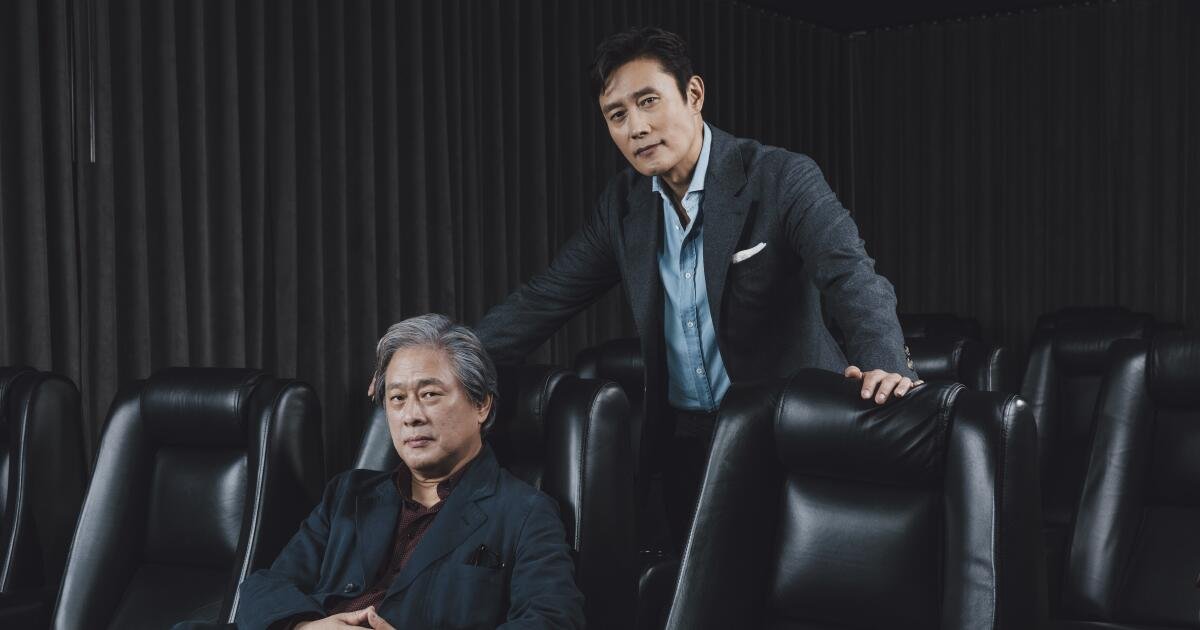
Lee Byung-hun looks every inch one of Korea’s biggest stars, debonair in his natty, slim-fitting suit, relaxing in this glass-walled room by the pool of a West Hollywood hotel. The happy tourists don’t notice Park Chan-wook, the cinematic master behind such tours de force as “Oldboy” and “Decision to Leave,” projecting thoughtful politesse beside him. These two giants of Korean film hadn’t made a feature together since 2000’s “Joint Security Area” (though they collaborated on a segment of the 2004 horror anthology “Three … Extremes”). It took a satirical American novel chronicling capitalism’s crushing effects on a schlubby, middle-age dad to reunite them for Oscar submission “No Other Choice.”
“Even if I didn’t like the character or story that he posed, I would’ve still participated because it’s director Park. He has another level of storytelling,” says Lee, speaking, like Park, through an interpreter. “From previous projects, I know his process is incredibly joyful and full of laughter. So I knew I could look forward to the experience.”
Park says he started developing the project as an American film about 20 years ago, so he didn’t think of casting Lee as the middle-age company man at its center. But when it finally came together as a Korean project instead, Lee “had reached the right age for the role. So before I started the adaptation process for the [Korean] screenplay, I had him in mind for the main character, Man-soo.”
Donald Westlake’s 1997 novel, “The Ax,” concerns a family man who is laid off from his job as a manager at a paper company. After a long period of unemployment, he identifies his top competitors for jobs — and sets out to murder them. A 2005 screen adaptation by Costa-Gavras did not deter Park from working out his own version, leaning into themes of the cruelty and absurdity of capitalism.

Lee Byung-hun in “No Other Choice.”
(Neon)
“This man, after he gets fired, doesn’t target those who have directly harmed him, but, strangely enough, goes for those who are equally as pitiful as him,” says Park. “The just target should have been the company or even the capitalist system as a whole. He went after the wrong target.”
It’s unusual to consider an awkward, suburban dad and company stalwart being an acting stretch, but Lee is known for his dramatic intensity, action-movie heroism, even villainy. “No Other Choice” exhibits spasms of taut thriller and family melodrama, but its bare-knuckled satire, sprinkled with slapstick, plays as Park’s funniest film.
“It is true that this film is more comedic in nature, but my other films have also had elements of black comedy and dark humor,” says Park. “Doing that is in my nature; it all feels very intuitive.”
One sloppy murder attempt becomes full-on farce as Man-soo finds himself shouting marital advice to an intended victim over deafening music before the action devolves into a messy three-way scrum.
Known for his fighting ability, Lee calls the scene “the biggest obstacle for me … We’re biting and pulling, we’re rolling around. That is actually a lot more difficult than something choreographed.”
To Park’s grin of acknowledgment, Lee proudly takes credit for the height of physical comedy in the sequence, when the combatants messily grab for a fallen gun, resulting in an overhead shot of three struggling posteriors.


1. Director Park chan-wook. (Sela Shiloni / For The Times) 2. Star Lee Byung-hun. (Sela Shiloni / For The Times)
Park’s hard-nosed approach to his themes, his ability to elicit strong performances and his deft touch with complex material have built his lofty reputation. But so has his command of the tools of cinema. In “No Other Choice,” his transitions and visual juxtapositions convey profound themes beneath the satirical surface.
He visually compares Man-soo’s wife’s head to the shovel that will be used to help dispose of victims, and the family’s house is superimposed over a bonfire, implying what’s at stake. Man-soo is a constant gardener who uses strong wires to twist roots and branches as he needs; their later use suggests the unnatural shapes into which the capitalist system twists humans.
The presence of a performer of Lee’s standing raises the question of how the director works with actors.
“I’m sure you’ve heard of director Park’s reputation,” Lee says, smiling. “He never gets mad and is very gentlemanly and calm on set. But it boils down to something deeper than that, because what is demanded of you, whether you’re an actor or a crew member, is a level of your craft [at its highest]. What is being asked of you is extreme.
“But the atmosphere is very happy. Any new actor, crew member working with him, they might feel nervous. However, as someone who has already experienced working with director Park, I knew it would be very enjoyable.”
Park says, “His first question to me after reading the screenplay was, ‘Am I allowed to be funny?’ Because he said he was laughing as he read the script although [it’s] such a tragic situation.” Once Lee had the green light from his director to make a fool of himself, he was off and running.
In a scene involving a snake bite, Lee’s facial expressions were “funnier by twofold” compared to Park’s expectations. For a later scene when Man-soo is strolling, businesslike, toward his first attempted murder, Lee improvised a spastic callback to the earlier snake moment. Park laughs at the memory, then makes the interpreter giggle by saying, “I had no other choice but to leave it in.”