


War in Ukraine, and the hazardous role of the journalists who document it, fills the frame in two new documentaries. “2000 Meters to Andriivka” (premiering Nov. 25 on PBS), which captures the brutal campaign to reclaim a strategic village from Russian control, is director Mstyslav Chernov’s follow-up to 2024 Academy Award winner “20 Days in Mariupol.” “Love + War” (now streaming on Disney+ and Hulu), directed by “Free Solo” Oscar winners E. Chai Vasarhelyi and Jimmy Chin, focuses on Pulitzer Prize-winning conflict photographer Lynsey Addario and how she navigates the challenges of her work alongside marriage and raising two children. Chernov and Addario recently joined The Envelope over Zoom for a conversation about the films and their experiences. Here are edited excerpts.
How do you both cultivate your relationship with the people you’re photographing in these tense and dangerous moments?
Mstyslav Chernov: As you’re asking the question I’m thinking, ”Is there a real difference when we talk about connection with people while you’re making pictures, or you’re filming, and just normal life connection?” I don’t think it is possible to … enter people’s lives in the most vulnerable moments and document their suffering without first connecting to them as much as possible. So first and foremost, you figure out if people need help … and then you start photographing. Especially when you do more long-term work, people feel that you’re coming not with the purpose of taking something away from them, but rather to help them share.
So it’s the idea of generating empathy?
Lynsey Addario: I think it’s the empathy that people pick up on. There are many different types of photographers or documentarians, and I think that we all have a different style. These days, I’m not covering the front line as much, because I feel like my skills as a person and as a photographer are much better [suited] to doing more intimate stories removed from the front line. … It’s a lot about developing relationships, establishing that trust, where people trust me to tell their story — they trust my intentions as a photographer and as a person. In Ukraine, it’s more difficult for me, because I don’t speak Ukrainian, and I’m totally dependent on a translator or another journalist. Whoever I’m working with has to become my voice. It becomes a lot more difficult because I have to work with someone who has similar empathy.
Mstyslav, I was struck by the way your film shows how technology is not only changing war, but also the way that war is covered.
Chernov: I’ve been thinking a lot about how the development of military technologies has pushed forward technologies of filmmaking. That’s not only a story of the modern age. Probably the construction of the rotating film in a camera came from the Gatling gun. War technologies are developing very rapidly. That gives us a possibility to cover war in a way that was never possible before. It allows us to push the documentary genre into a new space. Now the audience can not just watch the experiences of soldiers on the front line, but experience what they see and what they feel through the helmet cameras and the combination of different mediums… In the last two years the warfare changed radically. It’s impossible for a journalist or a filmmaker to walk to the front line and not get killed. Those stories are gone. We can’t do it anymore because of the precision of drones/AI/robotic systems that are currently in place, so we need to look for new ways to tell those stories.


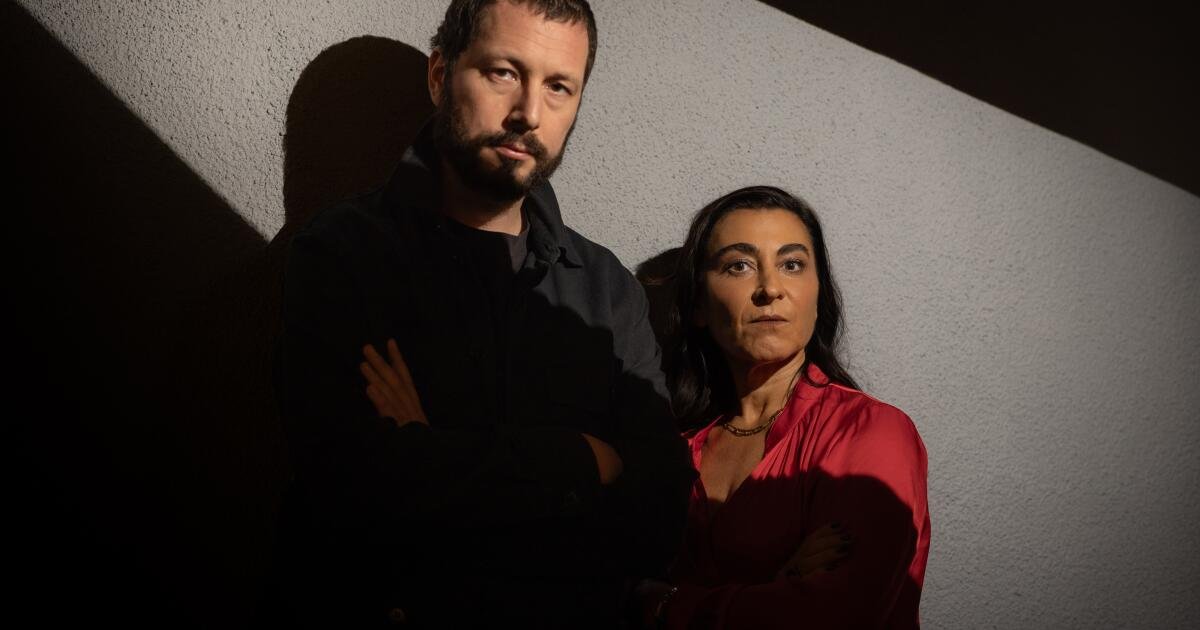
1. Lynsey Addario. 2. Mstyslav Chernov. (Jason Armond / Los Angeles Times)
You’ve both had close calls. Lynsey, you were kidnapped twice. Mstyslav, you’ve been assaulted and wounded by stun grenade shrapnel. How do you process the emotional impact of your work?
Chernov: I’m always having difficulties talking about my emotions, especially being part of Ukrainian culture. My father used to tell me, “Mstyslav, nobody’s interested in your emotions. Don’t show them.” Basic part of my education.
Addario: That’s funny. Italian Americans are the opposite. It’s all about emotion. The first kidnapping in Iraq was only a day, and it was very traumatic, but it was fine. I mean, in retrospect, it was not. It was a learning curve, let’s say, and I had to navigate how I would deal with life-threatening or close calls moving forward. And my decision after Iraq was that I would not just get on the first plane and leave — that I wanted to work through whatever I go through. Libya was rough … Every second it was unclear whether we would make it … I have to convince myself that it’s worth it and that I’m making some sort of change, either to someone’s perspective, to public policy, to lawmakers, to just regular people who are learning about the world through my pictures and my stories.
Chernov: The only thing I wanted to say is sometimes you don’t want to guard yourself … You strip yourself of your protections in order to get engaged with emotions and with the story you’re telling. That’s incredibly painful, but you can’t come to someone’s funeral who was part of your community or your friend, or even people you don’t know, and be just chill about it. You embrace the sadness, you embrace the loss, and you mourn together with this community. And that’s when I think the real work starts, because the audience feels this too.
Lynsey, your film explores the difficult balance between your work and your family life — being a mom.
Addario: When I started covering war, I never thought I would have children. It was not something that I even thought would be possible, because I was always on the road, and my true love was photographing. When I met my husband, and he offered to quit his job and be the primary caregiver of our kids, I thought, “OK, let’s try it.” But I also knew that it would compromise me in the sense that I would then suddenly be aware of my mortality. I’d have to be more cautious. I’d be constantly torn between these two worlds. And essentially, that’s what the film is about … My kids understand, maybe the 6-year-old doesn’t, but my 13-year-old, he understands now what I do. I just showed him the movie last week, and it was very difficult. I can only hope that one day they understand why I’m never home. My 6-year-old thinks I make banana bread for a living because I come home and I bake.
Chernov: It’s not that easy to bake a good banana bread. The world is getting worse. When we were growing up before the war started in Ukraine, I had a feeling that a better world is ahead of us. I feel now that is actually behind us. It gets only darker as we are going forward. And so if it is true, if it’s not just my biased, tired, pessimistic view of the world, then you want to do everything possible, and for them to know that you at least tried your best to do something for them to be in a world where light is not behind, but somewhere over there, forward. So when the time comes, they will know.

Lynsey Addario and Mstyslav Chernov.
(Jason Armond / Los Angeles Times)