


Nothing can prepare you for the image of a child sitting alone in an American courtroom, expected to argue for her own right to safety.
Lucy is a 3-year-old girl in U.S. custody. She was one of 25 children scheduled to appear in immigration court in Arizona late last month. She could not climb into the chair on her own. A nonprofit attorney — unable to formally represent Lucy because her organization lost most of its federal funding earlier this year — lifted her into her seat and handed her a teddy bear to hold.
Lucy did not know where she was, nor did she understand the words being spoken around her. She could not possibly explain the dangers she had fled. And yet, under the system we have built, she was the one required to answer.
I felt grief before I felt anger — a heavy, stunned grief that this is who we have become: a nation willing to place the full weight of its legal machinery onto the shoulders of a toddler and then tell itself we’re simply following process.
But beneath that grief sits a truth I cannot shake: that a child stood alone before an imposing power — a power that should have done everything it could to protect her, and it did not.
What happened to Lucy was not a mistake. It is the outcome of a legal system that treats children’s immigration proceedings as administrative disputes rather than matters of basic human protection. Because these are civil hearings, the government provides no attorney. Immigrants — including children — may obtain representation, but if they cannot, the government has no obligation to provide one. That is how a 3-year-old ends up alone before a federal judge: a system built to process bodies, not safeguard lives, applied to a child for whom the stakes could not be higher.
For years nonprofit organizations tried to fill the gap the government refused to. But earlier this year the administration terminated federal funding for legal orientation and child-representation programs that allowed nonprofit attorneys to formally represent unaccompanied children in immigration court. Lawyers who once stood beside children now can offer little more than a few words from the gallery. When that thin safety net was cut away, children like Lucy were left with no one beside them.
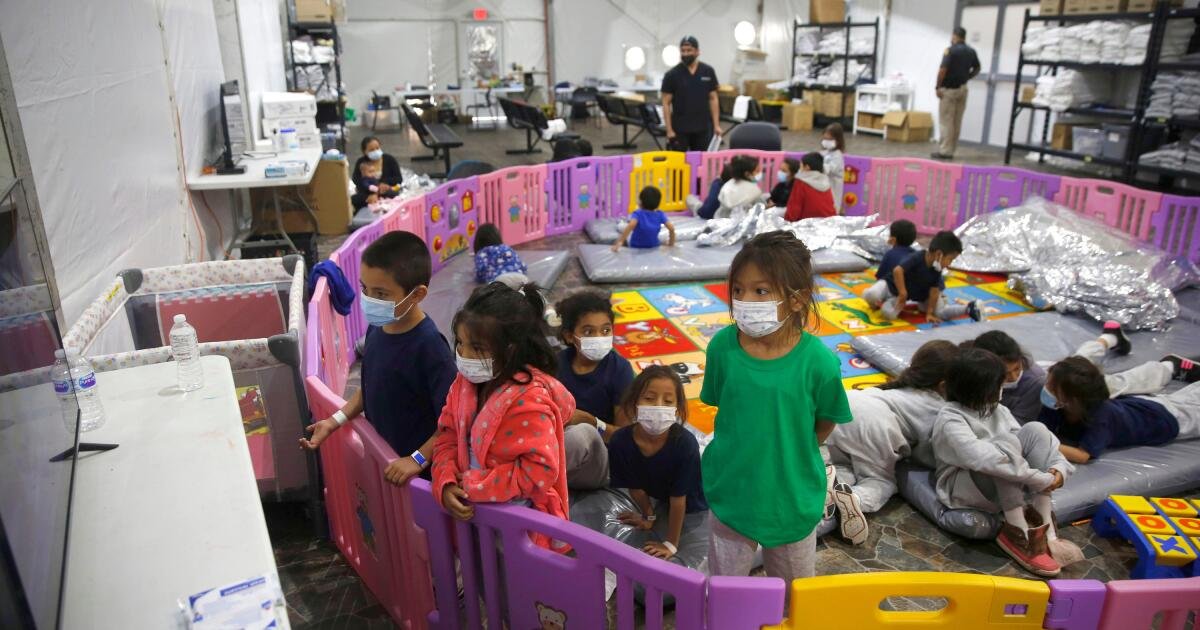
Unaccompanied minors are transferred to the Office of Refugee Resettlement (ORR), which contracts with shelters to hold them until they are released to a vetted sponsor or, if no sponsor is found, until they turn 18. Their detention can stretch for weeks or months, even as their removal cases grind forward.
But ORR is only one piece of a larger enforcement machinery. Associated Press reporting has documented hundreds of other children — including infants — held for months in Department of Homeland Security custody, in facilities marked by contaminated food, inadequate medical care and little oversight. Some have been kept in hotels under opaque contracts designed to avoid scrutiny. Across agencies and administrations, the pattern remains the same: a system built for enforcement, not for children’s welfare.
This is not happening because no one understands the harm. It continues because those who would stop it won’t. What should be unthinkable has become routine. That is how a federal judge can speak to a 3-year-old with the calm cadence of a normal hearing — as if she had any agency at all. How did we accept the absurd premise that this is what justice looks like for a child?
The result is a process in which children who cannot read, cannot understand the questions put to them and cannot articulate the dangers they face nonetheless are required to navigate life-altering legal proceedings as if they were capable adults. A system that treats toddlers as respondents and denies them advocates is a system that has lost sight of its most basic responsibility to protect the vulnerable.
The Immigration and Nationality Act states that children in removal proceedings may be represented by counsel “at no expense to the government.” How does a 3-year-old hire an attorney? How does a toddler who cannot read, cannot make a phone call, cannot understand the concept of “legal representation,” possibly secure counsel for herself?
We have given these children a right they have no human capacity to exercise and then reassured ourselves that the process is fair. It is a polite fiction that sounds almost civilized until you consider to whom that fiction is being applied.
And this is the part I cannot let go of: A child who could not climb into a chair was made to face the power of a nation alone. We built a system that sees her helplessness and proceeds anyway — knowing she cannot fight back. A nation’s character is revealed not by what it says it values, but by the cruelties it allows to become ordinary.
You don’t need to know Lucy’s history to understand what is being done in our name. You don’t need to know where she came from, what her parents hoped for, or what danger her family fled. You need only to understand what it means for a child — any child — to sit alone in a courtroom unable to speak for herself while the machinery of the state pretends she has a say in her fate.
This is not a question of procedure but one of character. Demanding that a toddler stand alone before the power of the United States is not enforcing order. It is abandoning morality.
Every American should be deeply ashamed of what is being done to these children in our name. A country that permits this cannot claim that it acts with honor. And a nation that refuses to protect the smallest and most vulnerable cannot claim to be good.
Jon Duffy is a retired naval officer. He writes about leadership and democracy.