


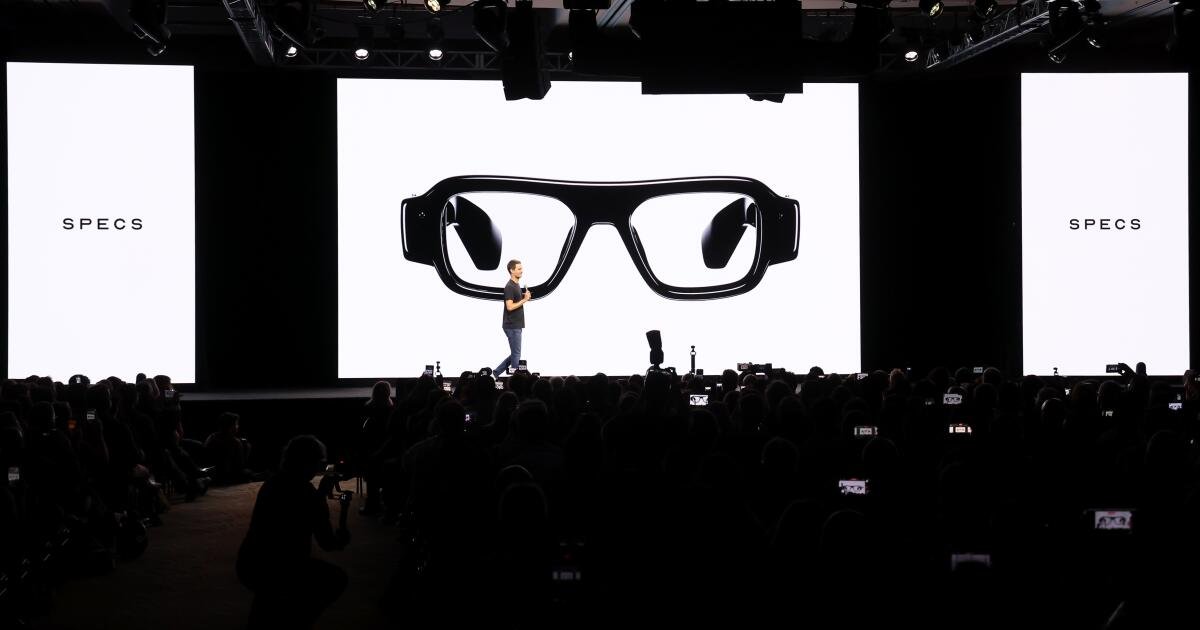
Social media company Snap on Tuesday showcased a pair of its $2,195 augmented reality glasses, staking a claim in a race to reshape how people interact with computers.
The Santa Monica tech company faces fierce competition as it takes on bigger rivals such as Meta that are dominating the sale of smart glasses and needs to convince more people to buy another gadget. Google is planning to release smart glasses in the fall and Apple is reportedly working on a pair as well.
The announcement also shows how the rising popularity of artificial intelligence-powered tools are fueling the release of hardware beyond the smartphone. While Snap and Google have failed to get consumers to buy smart glasses in the past, tech companies have been doubling down on the idea.
In a speech at the AWE conference in Long Beach, Snap’s chief executive and co-founder Evan Spiegel highlighted how people could do more with its AR glasses, Specs, than with rival products. He views the glasses as the next “major leap in computing.”
People can learn to play the drums, figure out how to fix their car, watch videos and more with the glasses, which are now available for preorder and are expected to ship in the fall. Augmented reality involves overlaying digital objects onto a person’s view of the physical world.
“The smartphone put our lives in our pockets, but augmented reality puts computing into the world where life actually happens, and that is the shift from phones to Specs,” Spiegel said.
Meta sells a variety of AI glasses, including a more expensive pair with a display and wristband that lets people ask questions to an AI assistant and answer calls and texts, along with other tasks. It’s also worked on a prototype of AR glasses called Orion.
Meta has a reputation of incorporating features released by Snap, the parent company of disappearing messaging app Snapchat. That has included a popular feature where photos and videos vanish in 24 hours.
“Those copycats up north aren’t going to be stealing this one,” said Spiegel, as the crowd erupted into applause and laughter.
While smart glasses aren’t as popular as smartphones, sales have grown.
Meta, which has a partnership with Ray-Ban, is leading in the sale of smart glasses without displays, according to the International Data Corporation. Roughly 2.25 million units of these glasses shipped in the first quarter of this year, a 167% jump year-over-year.
“Dethroning the giant that is Meta won’t come easy,” wrote Jitesh Ubrani, an IDC research manager in a post this week about smart glasses. “Meta’s core advantage isn’t just market share; it’s distribution.”
Meta has been expanding its retail footprint, opening up new stores in California.
But Snap will have to convince people that’s it’s worth paying $2,195 for a pair of AR glasses with more tech features. Spiegel pointed to the hefty price tags of the Mac in 1984 and Apple’s $3,500 mixed-reality headset.
“New computers almost always begin as something that just a few people can really afford,” he said.
On Tuesday, Snap’s share price dropped about 10%, closing at roughly $5.16.
Snap’s big bet on AR glasses comes at a crucial point for the company, which slashed 16% of its full-time workforce, or 1,000 workers, in April to cut costs. Snap this year also ended a deal with AI company Perplexity that was expected to bring the social media company $400 million.