


Next Monday marks the beginning of our annual Hispanic Heritage Month in the U.S. Historically, the yearly Sept.15 through Oct. 15 celebration has been a moment for recognition and education, with many Latin American countries feting the anniversaries of their independence from Spain.
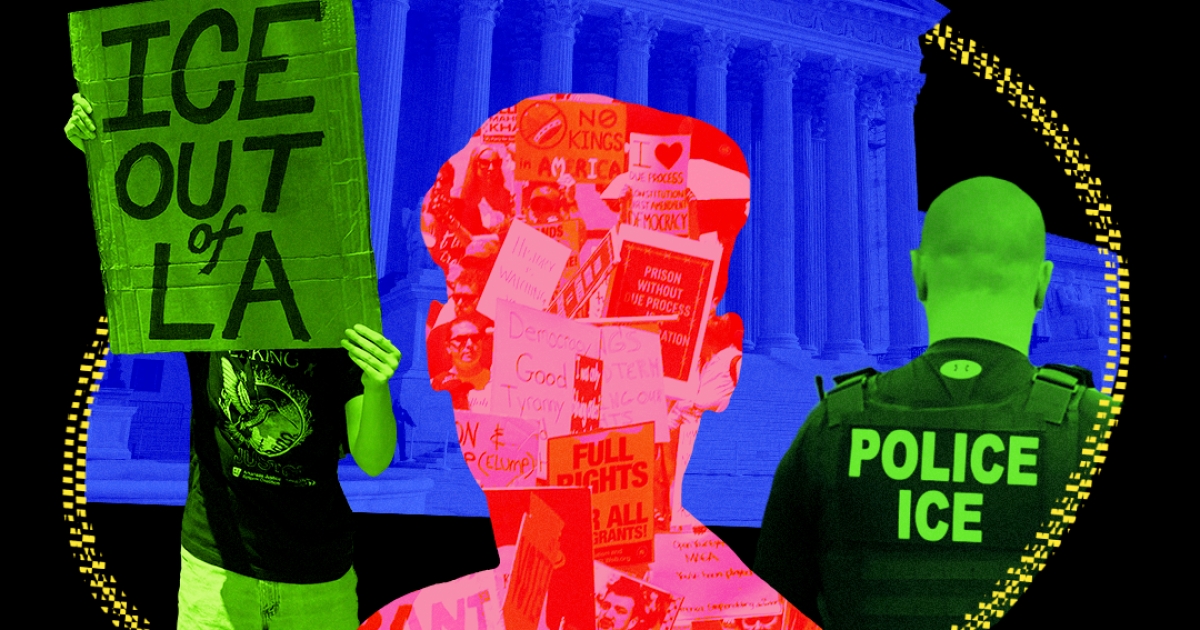
Throughout the month there will be a plethora of events to cheer on the occasion, but there will also be fear in L.A.’s expansive Latinx community, as Immigration and Customs Enforcement agents continue their raids in L.A. County.
On Monday, the Supreme Court ruled in a 6-3 vote to grant an emergency appeal and lift an L.A. judge’s order that barred “roving patrols” from snatching people off Southern California streets based on how they look, what language they speak, what work they do or where they happen to be.
The American Civil Liberties Union, Public Counsel, other groups and private attorneys filed the lawsuit in July on behalf of several immigrant rights groups — as well as three immigrants picked up at a bus stop and two U.S. citizens, one of whom was held despite showing agents his identification.
“When ICE grabbed me, they never showed a warrant or explained why. I was treated like I didn’t matter — locked up, cold, hungry, and without a lawyer. Now, the Supreme Court says that’s okay? That’s not justice. That’s racism with a badge,” said Pedro Vasquez Perdomo — a named plaintiff in the case — in a statement released by the ACLU after Monday’s ruling.
“I joined this case because what happened to me is happening to others every day just for being brown, speaking Spanish or standing on a corner looking for work,” added Vasquez. “The system failed us today, but I’m not staying silent. We’ll keep fighting because our lives are important.”
The court ruling in itself does not change basic due process for those arrested by immigration officials.
In her dissenting opinion, Justice Sonia Sotomayor wrote that Monday’s decision was “yet another grave misuse of our emergency docket. We should not have to live in a country where the Government can seize anyone who looks Latino, speaks Spanish and appears to work a low wage job.”
California Gov. Gavin Newsom also took aim at the Supreme Court decision in a statement Monday.
“This isn’t about enforcing immigration laws — it’s about targeting Latinos and anyone who doesn’t look or sound like Stephen Miller’s idea of an American, including U.S. citizens and children, to deliberately harm California’s families and small businesses,” Newsom wrote. “Trump’s private police force now has a green light to come after your family — and every person is now a target — but we will continue fighting these abhorrent attacks on Californians.”
As Latinx people look to joyously gather over the next few weeks for Hispanic Heritage Month, many want to know if it’s safe for them to go out and what to do if they cross paths with ICE agents.
My colleague Karen Garcia recently updated an article that outlines the rights of any one person when approached by ICE.
What to do if you encounter ICE agents
If ICE agents come to your home, legal experts and advocacy groups alike agree that the main thing to do is keep your door closed and locked.
If agents are able to provide a valid search warrant, you must open your door and let them inside your house. Agents must identify themselves clearly and can present warrants by slipping them under a door or putting them against windows
- What does a “valid search warrant” look like? “Look at the top and at the signature line to see if it was issued by a court and signed by a judge,” the ACLU advises. “Only a court/judge warrant grants ICE permission to enter your premises. One issued by DHS or ICE and signed by a DHS or ICE employee does not”
You have a right to remain silent and can refuse to answer any questions asked of you regarding immigration status. It is not required of you to sign any documents or share any personal information.
If taken into custody, you have a right to seek legal representation and receive a phone call from an attorney. You can show evidence of having a lawyer by presenting agents through a signed federal document that details your lawyer’s information and your consent to their legal representation — known as a Form G-28. If you don’t already have a lawyer, you can ask ICE officials for a list of pro bono lawyers. You can also ask to contact your country’s consulate, which may be able to help you land legal representation.
If someone you know is detained, certain immigrant advocacy groups can provide referrals, information and resources. Here’s a list of some organizations that may be able to help:
- Immigrant Defenders Law Center, (213) 833-8283
- Public Counsel, (213) 385-2977
- Legal Aid Foundation of Los Angeles, (800) 399-4529
- Lalama Immigration Law, (833) 838-8472
- Esperanza Immigrant Rights Project, (213) 251-3505
- Immigration Center for Women and Children (L.A. office), (213) 614-1165
- El Rescate, (213) 387-3284
- Central American Resource Center of Los Angeles, (213) 385-7800
- USC Gould School of Law Immigration Clinic, (213) 821-9627
- International Institute of Los Angeles, (323) 264-6217
- Asian Americans Advancing Justice Southern California, (888) 349-9695
- U.S. Africa Institute, (310) 951-7721
If someone has called you for help, collecting some of their important documents — such as birth certificates, medical records, previous visa applications and receipt and approval notices for any prior immigration applications — could be key. Other important information to take note of would be the detained person’s country of birth, their A-Number, their full legal name and their date of birth.
Who else is helping on the ground?
From day to day, Ingrid Villeda wears many hats.
As an employee of the L.A. Unified School District, she serves as the community school coordinator at 93rd Street Elementary, but she’s also a teacher who is an active member of the United Teachers Los Angeles labor union. Additionally, Villeda is the leader of the education section for Unión del Barrio — an independent political organization advocating for immigrant rights and social justice.
By 7:45 a.m., on the morning after the Supreme Court’s ICE-related ruling, Villeda had already participated in each of her jobs.
Before the start of the school day, she and a fellow Unión del Barrio member embarked on a community patrol in the neighborhood surrounding her workplace patrol to alert residents of immigration sweeps and inform them of their constitutional rights. The goal is to help make the vulnerable in the community feel safe.
“We’re continuing to patrol every single school to demonstrate to families that we do have eyes everywhere,” Villeda said. “It’s one thing to tell families that we’re here, but another thing to demonstrate that we’re here. Our plan is to to be able to refocus the patrols on school safety, be able to communicate a lot with the community and give them red cards [which highlight people’s rights and protections under the U.S. Constitution].”
She noted that the mentality behind UdB’s strategy has shifted from telling people to “know your rights” to imploring them to “defend your rights,” in light of rulings and policies at a national level.
UdB’s priority over the next few weeks is to make sure community members utilize the organization’s tip line and that people recognize that time is of the essence in ICE raid situations.
In spite of ongoing political decisions that might inspire caution in people around celebrating their heritage this month, Villeda said people should proudly represent where they’re from.
“We’re not going to be scared. We’re going to stand in our existence and we’re going to celebrate it because we deserve to celebrate it,” she said. “As far as Unión is concerned, we have a block party planned on the 13th in South Central. It’s Fight Night [Canelo Álvarez vs. Terence Crawford]. We’re going to have street vendors. We want folks to come out, because it’s important to us to let people know that we’re still out here. Existence is resistance.”
Villeda, who was born in Guatemala and became a U.S. citizen last year, understands what it’s like to move through the world as a non-citizen and wants parents and students alike to feel safe in and around her school.
As morning drop-off commenced for the day at the South L.A. school that is over 80% Latinx, children said goodbye to their families as parents soaked in one more long look at their kids before driving or walking away. Villeda helped usher students inside the campus gates while assuring concerned parents that their children will remain safe on campus. With students shuffling in, a utility worker put up a signs in English and Spanish that gave notice that there is are surveillance camera systems for security purposes in use on school grounds.
Some parents lingered outside the school gates, talking to each other about the Supreme Court’s decision and the anxieties permeating their community.
“Todo está en contra de nosotros,” one mother said to a group of fellow parents; or, “everything is against us.”
That morning, all the 93rd Street schoolteachers assigned to drop-off duty carried with them two important items: a walkie-talkie to communicate with fellow teachers and a flier that outlined why UTLA might go on strike again.
While explaining to one curious parent that members of UTLA are fighting to prevent LAUSD from freezing healthcare funding at the current rate, Villeda abruptly paused the conversation to radio her fellow educators. She clocked that a car had driven past the school several times without dropping a student and alerted the faculty of the suspicious behavior, as a precaution.
“Our students have the right to education, to be in school. No human being is illegal on stolen land. We are firm on believing that and we feel like this is all very unjust,” Villeda said of the current political moment. “Now, it’s legal to be racist and that takes everything to a different level. But we’re here to protect our communities, our parents and we firmly believe in our right to exist.”
As a bit of advice to concerned undocumented people, Villeda reaffirmed that people should not sign anything that an ICE agent presents them; that everyone has a right to legal representation and that it’s key to establish communication with a family member. She also recommended that parents prepare an emergency family plan.
“We want to make sure that the legal guardianship papers are done so that, in case you are a parent that’s unable to get back to your child, we’re able to mobilize quickly,” she said. “We also don’t want our children to be part of a system that’s already broken, which is the foster care system. So our parents [must be] ready and able to respond to those things.”
Villeda encouraged parents to practice role playing ICE agent interactions with their children, as well. She believes that children should know their 1st Amendment rights and that they don’t need to speak with strangers if they don’t feel like it. At her school, students as young as kindergarten age have been given red cards and instructed how to point to show the card’s information to ICE agents.
She also emphasized that there is strength in numbers, despite ICE’s re-granted opaque abilities, and that deflection tactics can be key in assisting community members.
“Can I blast my radio? And if I go by an agent and I’m playing Chalino Sanchez, am I going to get pulled over? If that’s a tactic that they’re going to use, then guess what? I’m going to play Chalino Sanchez every day because I’m documented,” Villeda said. “If they’re going to waste their time on me, I’ll speak Spanish in public places. I’ll play Spanish music and that’s how we divert, right? We have to use every technique of diversion.”
Stories we read this week that we think you should read
Unless otherwise noted, all stories in this section are from the L.A. Times.
Immigration and the border
Arts and Entertainment

(Jackie Rivera / For The Times; Martina Ibáñez-Baldor / Los Angeles Times)