


A brawny bodyguard shoves a bruised man, hands tied behind his back, toward the hood of a black SUV. A pen and a contract lay atop the metal, ready for a forced signature, while the man’s fiancee and her father watch in silence, seeking revenge on the person who betrayed them.
It has all the hallmarks of a prestige Hollywood thriller, but this high-stakes scene is being framed entirely for a smartphone screen. Issa Rae’s new viral TikTok micro-drama, “Screen Time,” was getting ready to wrap its final shoot day at her company, Hoorae Media, in Hyde Park.
“Let’s not have him shake his head,” said Rae, as she leaned closer toward the screen displaying the vertical video feed of the father eating from a bright yellow pouch of Gushers.
Within a week of its April release, “Screen Time” had gone viral, reaching nearly 75 million views and earning the highest watch time for a series on TikTok. Since it landed, the 57-episode vertical series, which follows two couples as they face off against a threatening online hacker in drama-fueled one-minute clips, has amassed more than 150 million views.
“Screen Time” is the latest success story in the booming micro-drama genre that is sweeping Hollywood. It was also the first vertical drama to be exclusively featured on TikTok, which helped to finance the series as it expands its presence in the space.
“Screen Time” is the first of four series that TikTok is producing in collaboration with Hoorae as it looks to diversify its audience and bring new users to the platform. Rival platforms like ReelShort, DramaBox as well YouTube already have expansive micro-drama collections.
“We are able to work with both creators on the platform and very prominent producers like Issa, who are huge in the traditional Hollywood sense of TV shows and films,” said Dawn Yang, the global head of entertainment partnerships at TikTok. “We’re just excited for the amount of creativity that it unlocks, and for our audience to discover them in the most organic way.”

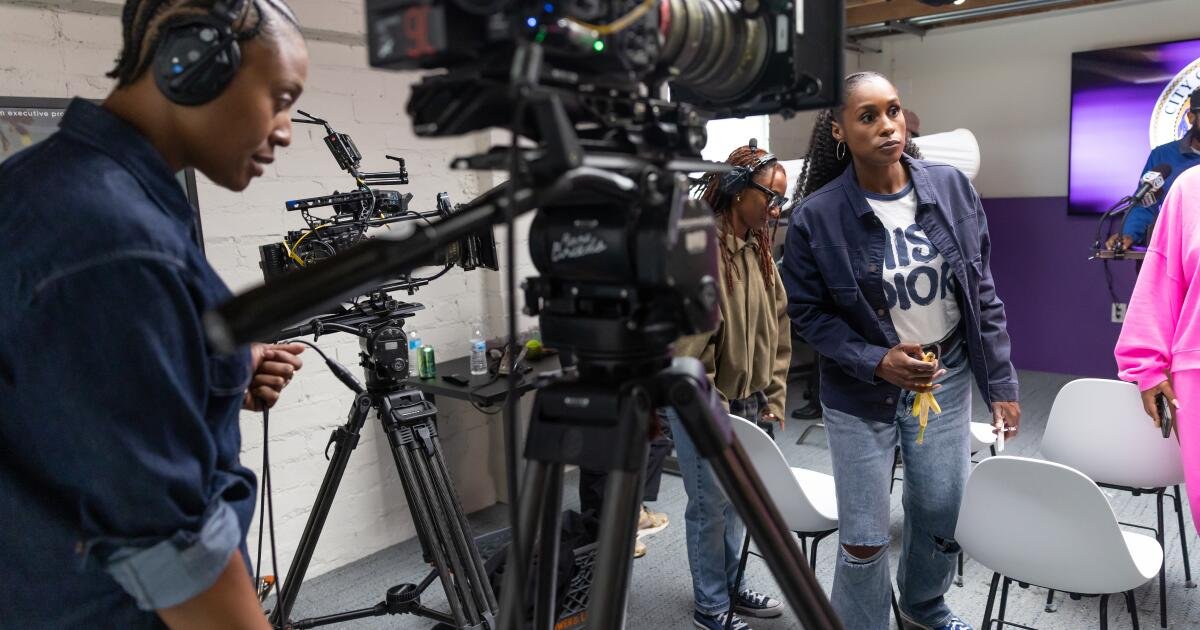
Assistant director Frederick Gourgue, center, works with the crew at Hoorae in Los Angeles on May 15.
The vertical video format first rose to popularity in China, where TikTok began. In 2024, revenue from micro-dramas surpassed domestic box office sales for the first time, with $6.9 billion according to digital research firm DataEye. Today, much of the industry’s revenue in China is coming from AI-generated series, where nearly 50,000 new A.I. micro-dramas were uploaded to Douyin, China’s version of TikTok, in March alone, said DataEye.
Disney and Fox Entertainment have also invested in the format. Most recently, Peacock announced both unscripted and scripted micro-dramas will hit its streaming service by summer. Other celebrities like Kevin Hart, Kim Kardashian and Taye Diggs have invested in the format, too. Even Rachel Sennott recently wrote and starred in a micro-drama to promote a new Marc Jacobs purse.
When a new format like micro-dramas starts to gain mainstream traction, social media platforms face pressure to adapt, said Joel Marlinarson, a social strategist and founder of marketing agency Coldest Creative.
“It’s in TikTok’s best interest to evolve formats that are working elsewhere,” Marlinarson said. “We know that micro-dramas have succeeded in the East, but it’s about bringing that to the West.”
“Screen Time” underscores how the genre is maturing away from “low brow, tacky content,” Marlinarson said.
Rae declined to disclose the budget for “Screen Time.” But she said the series, which was a union production, was backed by a six-figure investment from Hoorae Media and TikTok.

Actress Jenna Nolen, left, runs lines with director Kristen Brancaccio at Hoorae’s office.
Following the mainstream success of HBO’s “Insecure” and the critically acclaimed film, “One of Them Days,” where she served as head producer, Rae waited years for the perfect moment to return to the digital space.
With “Screen Time,” she channels her love for soap operas into the micro-drama format. By avoiding clichés and featuring a mostly Black cast, Rae’s mission for Hoorae’s new venture is simple: defy expectations and tell a great story.
“What attracts me to [micro dramas] specifically is the ability to still experiment online, tell stories, get an audience around them and own the IP,” Rae said, from her upstairs office in Hyde Park, as her team continued to shoot social promos below. “This is such a fun space to just be in and create what’s not in mainstream television or film … It’s less expensive and more low-stakes, and you can find out what works or you can move on.”
“Screen Time” is a return to form for Rae. As someone who was born in Los Angeles and continues to reside here, much of her creative efforts are tied to the city. One of the first projects she created was the YouTube series “The Misadventures of Awkward Black Girl” in 2011. The web series earned 20 million views and served as a basis for “Insecure.”
“Screen Time” doesn’t fit a typical micro-drama. While the genre is known for its low-brow content, featuring mostly white actors and fantasy motifs (like being a secret billionaire), Rae set out to create high-quality programming that centers Black characters.
Early on, she said, industry insiders questioned the viability of the “Screen Time” concept. She said the feedback only anchored her belief in the story, but also meant the production needed to capitalize on the qualities that make a micro-drama captivating — like regular cliffhangers and melodramatic moments.

Actor Xavier Antonio Avila, left, sits while Amber Burgin touches up makeup.
“I wanted to feel like it’s worthwhile for the actors, for the crew and for the audience,” she said.
The production was nearly wrapped when Yang and her team visited on the second-to-last day of shooting. The company wanted to launch a new kind of partnership between TikTok and Hoorae Media.
“We were going to make this without them, and they saw the vision,” Rae said, referring to TikTok. “They met us where we were. Doing this on our own was a testament to ‘if you build it, they will come.’”

The ‘Screen Time’ crew including sound mixer Chuck Hendy and 1st assistant director Frederick Gourgue, from left, in production at Hoorae’s office.
Rae equates vertical videos to short films or music videos, with their mobile-first format capturing audiences as they scroll, but she says it’s just one of many pathways to build and entertain an audience.
“This will be the accessible way to tell great stories, but I don’t think that it’s gonna replace television and film by any means,” Rae said. “I’ll be worried when TV screens change to vertical.”