


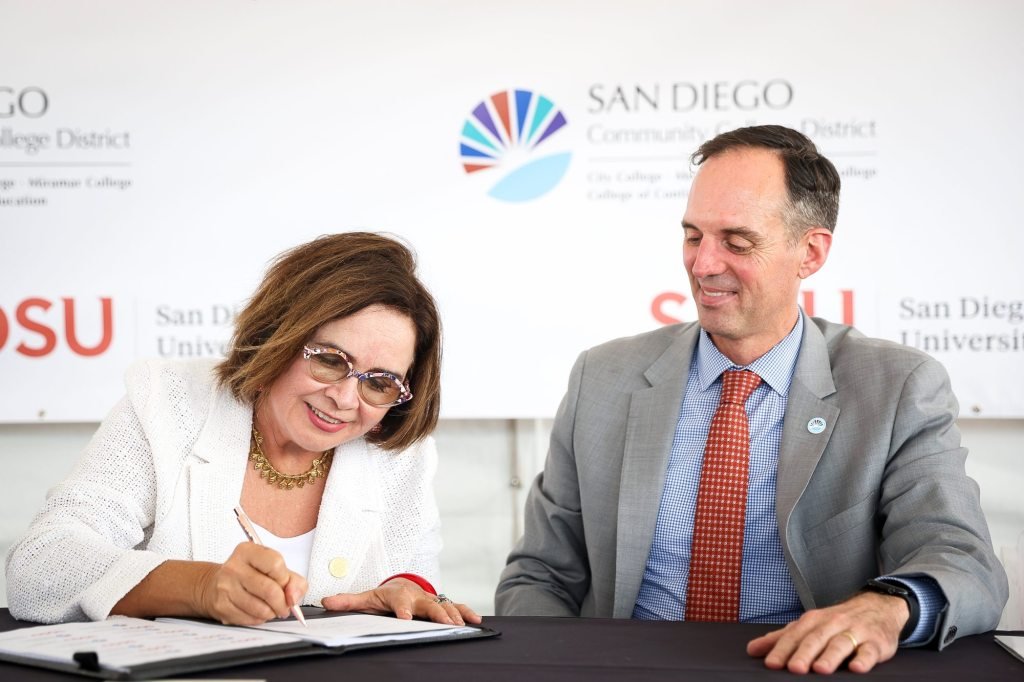

In an unexpected move, the San Diego Community College District is taking steps to build a major academic center on San Diego State University’s new Mission Valley campus to improve students’ chances of transferring to four-year colleges and universities.
The institutions signed a nonbinding agreement Thursday that envisions creating a shared five-story building in which students majoring in science, technology, engineering and mathematics fields would be advised and taught by faculty from both schools.
The details have yet to be worked out. But the 100,000-square-foot center would likely be located near Snapdragon Stadium, in SDSU’s proposed Innovation District, an education and research hub with industry partners.
The project could become one of the first collaborations in which a California State University campus and a big community college district co-develop and co-locate academic programs in a shared space, officials from both said Thursday.
The proposal is meant to help deal with a longstanding problem: Despite numerous and varied efforts, the state’s community colleges see a fairly low share of their students transfer to four-year universities.
Statewide, only 19% of community college students who enrolled with intentions of transferring to a university do so within four years, a 2023 study by the Public Policy Institute of California found. Those who do transfer tend to fare well in bachelor’s degree programs, PPIC added.
SDCCD declined to provide its own transfer rates.
In general, students fail to transfer for a variety of reasons, including a lack of guidance and confusion over which specific course requirements they need to fulfill to be admitted into specific universities, according to California’s Campaign for College Opportunity.
On Thursday, SDSU President Adela de la Torre addressed the problem, saying her school will guarantee admission to eligible students from SDCCD’s San Diego City, Mesa and Miramar colleges.
The pledge comes as SDSU is bursting at the seams. Enrollment is expected to surpass 40,000 for the first time this fall.
The proposed academic center “is bold, it is innovative, it is a collaboration of two of the region’s largest public higher education institutions,” said de la Torre, an economist. “Together, we can offer degrees in an accelerated fashion and align our missions.”
The idea has also energized Gregory Smith, chancellor of SDCCD.
“More than 75% of our students tell us their goal is to earn a baccalaureate degree, a master’s degree or a doctoral degree,” he said. “One hundred percent of our students aspire to earn a living wage, provide for their family and live with dignity.”
SDSU has long said that it would create classroom facilities at its Mission Valley campus off Interstate 8. But it had not previously indicated plans to partner with a community college district to create a shared academic center by its stadium.
Initial plans call for SDCCD to occupy four of the building’s five stories. SDSU would take the other.
SDCCD would likely pay for most of the construction costs. It’s not uncommon for buildings of that size to cost upward of $100 million.
But the source of funding isn’t immediately clear.
Last fall, voters approved a $3.5 billion bond measure devoted to upgrading and repairing classrooms and facilities. The district said the money can also be used to construct buildings.
Thursday’s proposal isn’t the only ambitious partnership recently made involving a local community college and CSU campus.
Southwestern College in Chula Vista has brought in Cal State San Marcos to offer five bachelor’s degree programs at a new center on its campus that will host faculty from visiting universities.
UC San Diego might add two bachelor’s degree programs, including one in public health, to that Southwestern center as well, and SDSU is considering placing a bachelor’s degree nursing program at Millenia, a new city-owned building that will open a short distance from Southwestern.
Local political leaders point to Southwestern’s moves as a potential model for co-locating branches of CSUSM, UCSD and SDSU in shared facilities of a different piece of city property.
Originally Published: