


Book Review
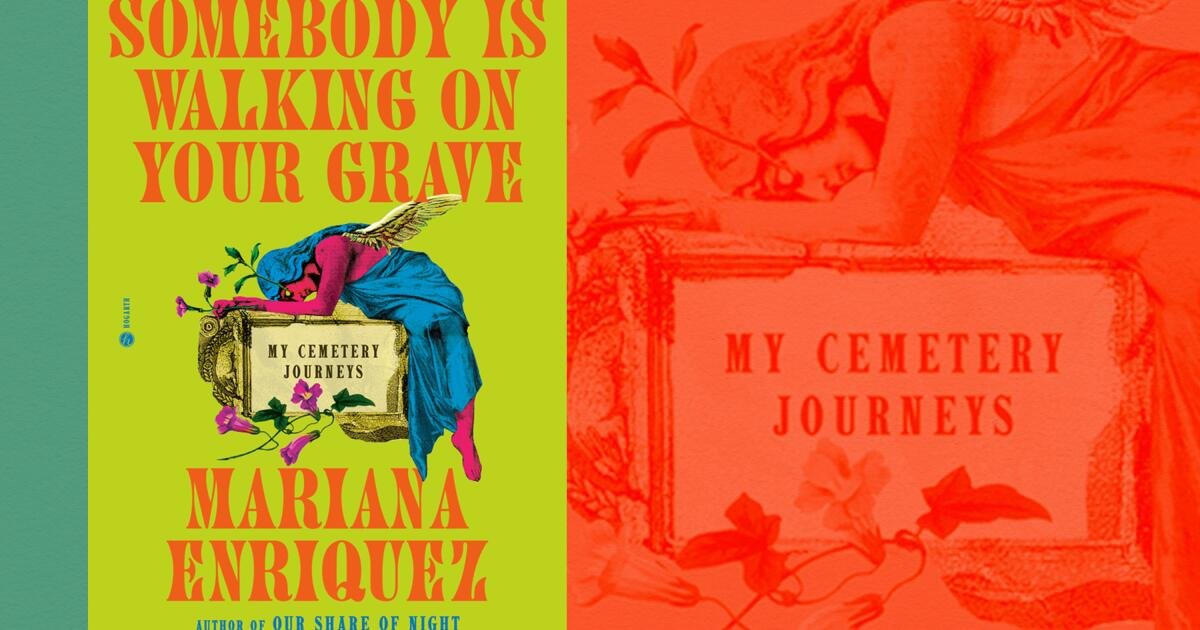
Somebody Is Walking on Your Grave: My Cemetery Journeys
By Mariana Enriquez; translated by Megan McDowell
Hogarth: 336 pages, $30
If you buy books linked on our site, The Times may earn a commission from Bookshop.org, whose fees support independent bookstores.
A stone’s throw from my apartment, Brooklyn’s Green-Wood Cemetery is its own dreamscape: 478 acres of parkland laid out in the 19th century, with weathered plots, granite sculptures, mausoleums for the wealthy, all set amid rolling ridges and ravines fringed by elms and azaleas. Boss Tweed is buried at Green-Wood, as are Jean-Michel Basquiat and Frank Morgan, who played the humbug Wizard in “The Wizard of Oz.” There’s an abundance of small slabs, simple epitaphs like Our Baby. Occasionally, my wife and I pause to read as we amble across to visit our late son, inurned near a Gothic Revival gate crowned by nests of monk parakeets. His marbled niche looks onto a koi pond, a patch of wisteria.
In her reflective, pitch-perfect collection of linked essays, “Somebody Is Walking on Your Grave,” the great Argentine writer Mariana Enriquez guides us through 21 of the world’s distinctive cemeteries. Renowned as a queen of literary horror — her stories brim with ghosts, werewolves, zombie infants — here she reveals a realist side, journalistic yet intimate. She structures her book as a travelogue, skipping from continent to continent; each chapter’s a banger, rendered in a luminous translation by Megan McDowell.

Cemeteries are invaluable compasses, a theme that binds Mariana Enriquez’s essays, and “Somebody Is Walking on Your Grave” is an immersive testament to her genius.
(Nora Lezano)
Enriquez opens in 1997, when she meets a slender street musician, Enzo, while on vacation in Italy and indulges in a fling. He takes her to Genoa’s Staglieno Cemetery, where they wander among tombs and have sex, stirring her imagination: “An infernal female figure standing atop a grave. The Canale tomb, its exquisite sleeping girl with her hair spread over the pillow, and the angel of death, another girl — a ribbon in her hair — who is coming to whisk her away, lesbian curiosity in her pious eyes. On the Fassio tomb, a beautiful cadaver, this, svelte, wrapped in a shroud.” Her romance fizzles, but a passion is born: She’ll now explore cemeteries around the globe, musing on the tales they tell, the cultures they mirror.
An avid researcher armed with a camera, Enriquez is both reporter and pilgrim. (She includes photos.) In London’s Highgate she poses before Karl Marx’s marker. She steals a bone from Paris’ Catacombs. She travels to Savannah’s Bonaventure graveyard, abutting the Wilmington River, “where shrimp boats float, a mostly silent river that is only audible when a breeze shakes the trees and you hear the water whisper.” She pays tribute to her native Buenos Aires’ Recoleta and Argentina’s “dirty war,” which claimed the lives of thousands of innocents.
Her fiction often cloaks political parables. (“Our Share of Night,” Enriquez’s epic novel, examines the legacy of Argentina’s fascistic dictatorship through the prism of a demon cult.) She leaves plenty of blood and gore on the page, which explains why “Somebody Is Walking on Your Grave” feels like a departure: It confronts mortality in a warm, inviting tone, embracing the liminal space between the dead and living. In Mexico, for instance, that space is joyously celebrated in annual Day of the Dead festivities, with its skeleton trinkets and pan de muerto, sweet buns served at family gatherings.
Enriquez describes her awe at domed sepulchers in Havana. She falls hard for New Orleans, seeking traces of voodoo, “something more than just a souvenir doll or a little bag of gris-gris or a pink love potion, or a guide who will repeat his stories for twenty bucks,” she writes. “I have no way to get to the Louisiana swamps where, it’s said, you can still find voodoo priestesses living in trailers. I don’t have a car. And having no car in the United States is like not having a pulse.” Language itself wards off evil. Basque headstones are inscribed in Euskara, the oldest European tongue; Enriquez’s friend shouts in Euskara to scare away an intruder.
Social commentary percolates throughout the book. Enriquez, a 2022 finalist for a Los Angeles Times Book Prize, has long been a kind of rock ’n’ roll maverick in the mode of Rachel Kushner — there are references to Joy Division, Nick Cave and AC/DC — but at heart she’s a moralist. Beneath her rich surfaces, we find steely accounts of injustice and resilience. Nations gamble with the fates of their citizens; Enriquez is “outraged that the domination is so obvious and not even death can overcome it.” She’s morbidly fascinated by racial and class segregation among cemeteries.
On Western Australia’s Rottnest Island, where her partner (and eventual husband) works, she discovers an untended graveyard of perhaps 400 Aboriginal peoples. At Martín García Island, Argentina, a series of crags amid the Río de la Plata delta, she tries to make sense of crooked crosses cast from a single mold. (Political prisoners were housed here, including Juan Perón.) She journeys to Chile’s remote Punta Arenas, home to the scenic Sara Braun Municipal Cemetery, a profusion of pruned cypress trees and a statue of an Unknown Indian. “He wears necklaces, crucifixes with huge agonizing Christs, and bracelets, and he’s practically covered with flowers. It’s an explosion of color and feeling,” Enriquez observes, “and, as always in these cases, an attempt to mitigate any fury. Turning the Unknown Indian into a saint is better than the other possibility: that he become an avenger.”
Historical memory, she suggests, has never been more necessary. Empires continue to spark atrocities; and in our moment of rising authoritarianism, we must look to the past for clues to the future. Grief, too, steers us, a cleansing ritual, as I recall each time my wife and I meander beneath Green-Wood’s leafy canopy, parakeets swooping and chattering overhead, or sit quietly in its hushed chapel. Cemeteries are invaluable compasses, a theme that binds Enriquez’s essays, and “Somebody Is Walking on Your Grave” is an immersive testament to her genius.
Cain is a book critic and the author of the memoir “This Boy’s Faith: Notes From a Southern Baptist Upbringing.” He lives in Brooklyn, N.Y.