


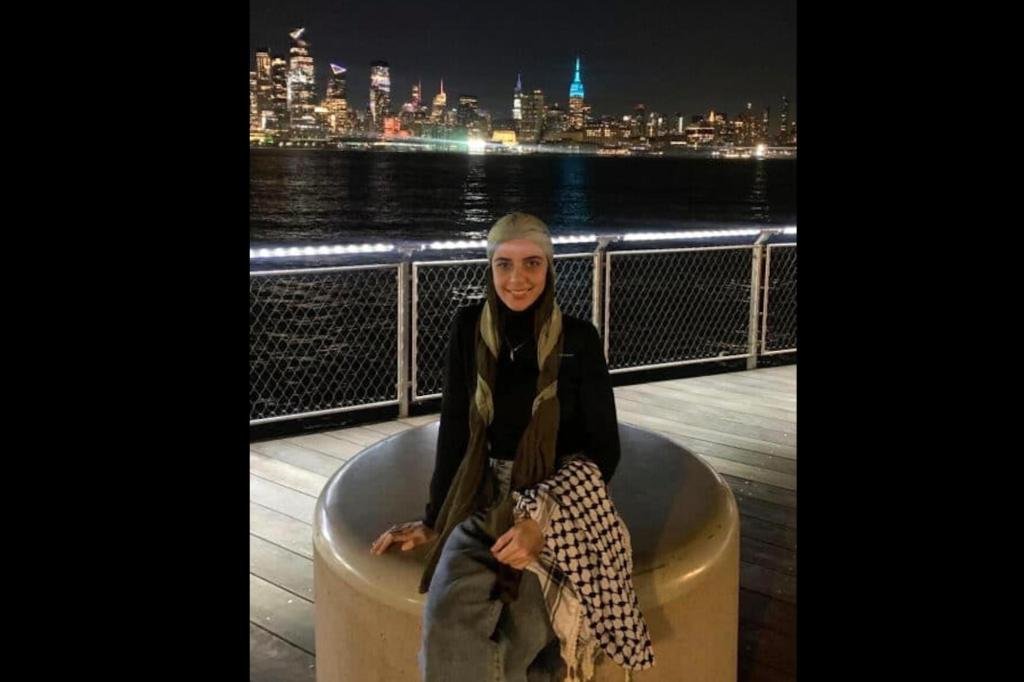
By JAKE OFFENHARTZ and ADAM GELLER, Associated Press
NEW YORK (AP) — Growing up in the West Bank, Leqaa Kordia was separated from family in Gaza by Israeli restrictions on movement between the territories. So aunts and uncles in Gaza would call from the beach there, allowing Kordia to share her cousins’ laughter and glimpse the waves.
Now many of those relatives are dead, killed in the war that has destroyed much of the Strip. And more than 200 days after Kordia was swept up in the Trump administration’s crackdown on pro-Palestinian protesters, she despairs over being unable to give her family a voice.
“Most days I feel helpless,” said Kordia, 32, speaking from a Texas immigration detention center where she has been jailed since March. “I want to do something, but I can’t from here. I can’t do anything.”
Kordia, a Palestinian who has lived in New Jersey since 2016, was one of the first arrested in the government’s campaign against protesters, many of them prominent activists. All the others have gained release.
Only Kordia — mischaracterized by the government, largely overlooked by the public and caught in a legal maze — languishes in detention. That is, in part, because her story differs from most others who thronged campuses.

When she joined demonstrations against Israel outside Columbia University, she wasn’t a student or part of a group that might have provided support. As the arrests of activists like Mahmoud Khalil drew condemnation from elected officials and advocates, Kordia’s case largely remained out of the public eye.
And Kordia has been reluctant to draw attention to herself.
In her first interview since her arrest, Kordia said recently that she was moved to protest because of deep personal ties to Gaza, where more than 170 relatives have been killed. The government has cast those ties as suspect, pointing to Kordia’s money transfers to relatives in the Middle East as evidence of possible ties to terrorists.
Lawyers for the Department of Homeland Security didn’t reply to calls for comment. An agency spokesperson declined to answer questions about the case.
In a blistering decision this week, a federal judge found the Trump administration unlawfully targeted protesters for speaking out. That ruling isn’t binding, though, in the highly conservative district where Kordia’s case is being heard.
“The government has tried again and again to muster some kind of justification to hold this young woman in custody indefinitely,” said her immigration attorney, Sarah Sherman-Stokes. “It doesn’t seem to matter to them that they have no evidence.”
‘Go to the streets’
Kordia grew up in the West Bank city of Ramallah. Her parents divorced when she was a child and her mother remarried, eventually becoming a U.S. citizen. In 2016, Kordia came to the U.S. on a visitor’s visa, staying with her mother in Paterson, New Jersey, which is home to one of the nation’s largest Arab communities.
Soon after, Kordia enrolled in an English-language program and obtained a student visa. Her mother applied to let Kordia remain in the U.S. as the relative of a citizen.
The application was approved, but no visas were available. Government lawyers say Kordia has been in the U.S. illegally since she left school in 2022, surrendering her student status and invalidating her visa. Kordia said she believed then that her mother’s application assured her own legal status and that she mistakenly followed a teacher’s advice.
Kordia worked as a server at a Middle Eastern restaurant on Paterson’s Palestine Way while helping to care for her half brother, who has autism.
Those routines were upended in October 2023, after Hamas attacked southern Israel, killing about 1,200 people and taking 251 hostage. Israel responded with a massive military campaign, killing more than 66,000 Palestinians, according to Gaza’s Health Ministry, part of the Hamas-run government.
In calls with relatives in Gaza “they were telling me that ’We’re hungry. …We are scared. We’re cold. We don’t have anywhere to go,” Kordia said. “So my way of helping my family and my people was to go to the streets.”

Kordia said she joined more than a dozen protests in New York, New Jersey and Washington, D.C. In April 2024, she was arrested with 100 other protesters outside Columbia’s gates — charges quickly dismissed by prosecutors and sealed.
Soon after taking office, President Donald Trump issued executive orders equating the protests with antisemitism. DHS intelligence analysts began assembling dossiers on noncitizens who criticized Israel or protested the war, based on doxing sites and information from police.
“To all the resident aliens who joined in the pro-jihadist protests, we put you on notice,” Trump said in a fact sheet accompanying the orders. “Come 2025 we will find you and we will deport you.”
Surveillance, arrest and confusion
In March, immigration agents showed up at Kordia’s home and workplace, as well as her uncle’s house in Florida. “The experience was very confusing,” she said. “It was like: Why are you doing all this?”
Kordia hired a lawyer before agreeing to a March 13 meeting with Immigration and Customs Enforcement officials in Newark. She was detained immediately and flown to Prairieland Detention Center, south of Dallas.
Once there, she was assigned a bare mattress on the floor and denied religious accommodations, including Halal meals, her lawyers said.
When her cousin, Hamzah Abushaban, visited Kordia about a week after her arrest, he was taken aback by the dark circles under her eyes and her state of confusion.
“One of the first things she asked me was why was she there,” Abushaban said. “She cried a lot. She looked like death.”
“I must’ve asked her a thousand times, like, you’re sure you didn’t commit a crime?” he said. “What she thought and I thought was probably going to be a few more days of being detained has turned into almost, what, 7 months now.”
Kordia said that she didn’t understand the reasons for her detention until a week or two later, when a television at the facility was tuned to news of protester arrests.
“I see my name, literally in big letters, on CNN and I was like, what’s going on?” she said.
Payments scrutinized
Administration officials touted Kordia’s arrest as part of the deportation effort against those who “actively participated in anti-American, pro-terrorist activities.” A DHS press release noted her arrest the previous year at a “pro-Hamas” demonstration, mistakenly labeling her as a Columbia student.
Court papers show New York police gave records of her dismissed arrest to DHS — an apparent violation of a city law barring cooperation with immigration enforcement. Federal officials told police the information was needed in a criminal money laundering investigation, a police spokesperson later said.
At a bond hearing weeks later, government attorneys argued for Kordia’s continued detention, pointing to subpoenaed records showing she had sent “large amounts of money to Palestine and Jordan.”
Kordia said she and her mother had sent the money, totaling $16,900 over eight years, to relatives. A $1,000 payment in 2022 went to an aunt in Gaza whose home and hair salon had been destroyed in an Israeli strike. Two more payments last year went to a cousin struggling to feed his family.
“To hear the government accusing them of being terrorists and accusing you of sending money to terrorists, this is heartbreaking,” Kordia said.
An immigration judge, examining transaction records and statements from relatives, found “overwhelming evidence” that Kordia was telling the truth about the payments.
That judge has twice ordered her released on bond. The government has challenged the ruling, triggering a lengthy appeals process — highly unusual in immigration cases that don’t involve serious crimes.
Typically, when the government goes after someone for overstaying a visa, they are rarely arrested, let alone held in prolonged detention, said Adam Cox, a professor of immigration law at New York University.
“The kind of scale and scope and publicness of the campaign against student protesters by the Trump administration is really nothing like we’ve seen in recent memory,” said Cox, who studies the rise of presidential power in immigration policy.
‘One person left behind’
Kordia has sought release in federal court, the same path taken by Khalil and others. Whether she succeeds may depend on an appeals court in New York, which heard arguments this week from government attorneys who contend that such relief should be largely off-limits to noncitizens.
Khalil, who was freed in June, said he had followed Kordia’s case closely, asking lawyers to relay messages and reminding his supporters “that there is one person left behind.”
“She came straight from the West Bank, escaping the daily ordeals of settlers and administrative detention only to deal with a version of that here,” said Khalil, referring to Israel’s practice of jailing some Palestinians indefinitely without charge or trial. “It breaks my heart that she’s going through all of this.”
As detention stretches on, Kordia said it’s been difficult to follow developments in the war, let alone maintain contact with relatives caught in the conflict.
But it’s provided many hours to think about a time when the war is finally over and she can find peace.
That would start by being reunited with her mother and other relatives, she said, and maybe one day having a family of her own. She dreams of opening a cafe and introducing people to Palestinian culture through food. She wants to pursue an American life.
“That’s all I wanted, to live with my family in peace in a land that appreciates freedom,” she says. “That’s literally all that I want.”
Originally Published: