



What to Know
- The Supreme Court issued a decision Monday that lifts restriction on tactics used during immigration enforcement operations in Los Angeles.
- The restraining order handed down in July barred agents from using certain tactics during the raids, such as stopping people based solely on race, language, job or location.
- The Trump administration argued the restraining order wrongly restricted agents from carrying out its sweeping crackdown on illegal immigration.
- Justice Brett Kavanaugh, who sided with the conservative majority in Monday’s decision, questioned whether the tactics violate the Constitution.
- Justice Sonia Sotomayor cited the Constitution’s Fourth Amendment, which protects against unlawful searches and seizures, in her rebuke of the conservative majority’s decision.
- A lawsuit, filed by immigrant advocacy groups, from which the restraining order stemmed will now continue to make its way through the courts.
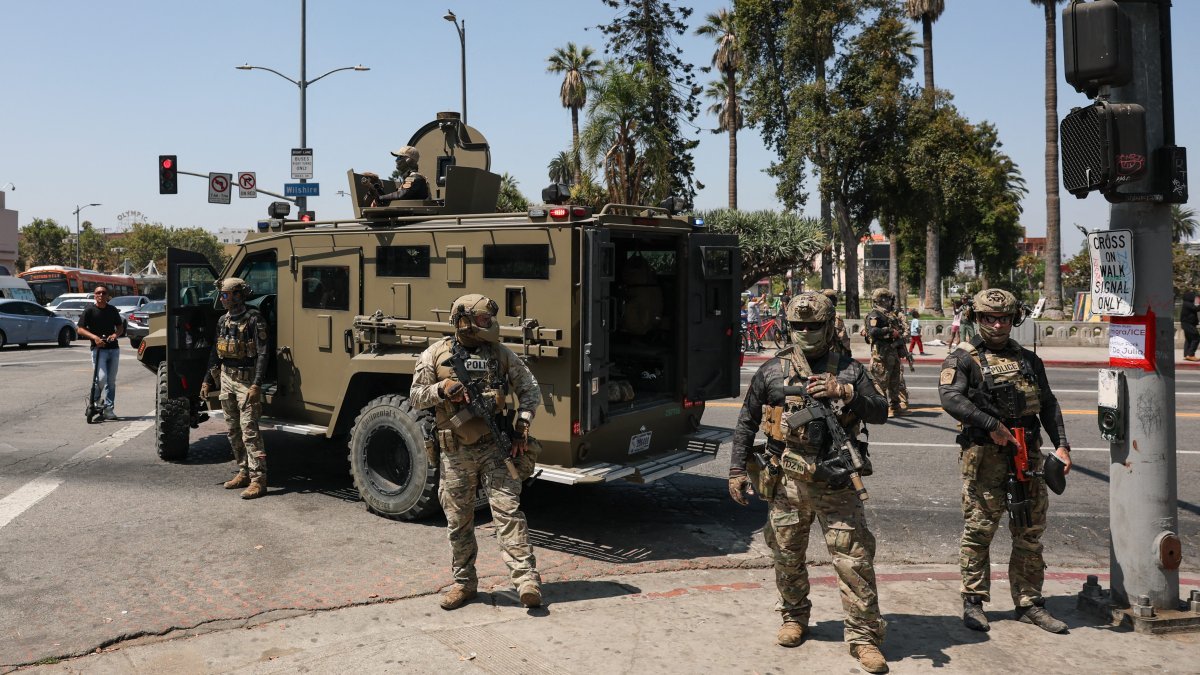
The Supreme Court lifted a restraining order granted by a judge and cleared the way for federal agents to carry out sweeping immigration enforcement operations in Los Angeles.
The high court’s 6-3 decision handed the Trump administration a victory in its mass deportation effort, a campaign promise that has included months of federal immigration operations in Los Angeles at car washes, home improvement store parking lots and other locations. The restraining order granted July 11 by U.S. District Judge Maame E. Frimpong in Los Angeles barred agents from using certain tactics during the raids, such as stopping people based solely on race, language, job or location.
Citing a “mountain of evidence,” Judge Frimpong’s restraining order targeted tactics used by federal agents that she said were in violation of the U.S. Constitution. The restraining order stemmed from a lawsuit brought by U.S. citizens who were swept up in the raids, which intensified in early June.
An appeals court ruling in August left Frimpong’s order in place, which led the Trump administration to turn to the Supreme Court. The administration argued the order wrongly restricted agents from carrying out its crackdown on illegal immigration.
Justice Sonia Sotomayor issued a rebuke of the Supreme Court ruling that lifts restrictions on immigration enforcement operation tactics. She cited the Constitution’s Fourth Amendment, which protects against unlawful searches and seizures.
“We should not have to live in a country where the Government can seize anyone who looks Latino, speaks Spanish, and appears to work a low wage job. Rather than stand idly by while our constitutional freedoms are lost, I dissent,” Sotomayor wrote.
Justices Elena Kagan and Ketanji Brown Jackson joined Sotomayor in dissenting.
More than 1.2 million immigrants disappeared from the labor force from January through the end of July, according to preliminary Census Bureau data analyzed by the Pew Research Center. Amber Frias reports for the NBC4 News at 5 p.m. on Tuesday, Sep. 2, 2025.
Justice Brett Kavanaugh, who sided with the conservative majority in Monday’s decision, took issue with whether the tactics violate the Constitution. Kavanaugh, nominated by President Trump in 2018, said Los Angeles’ large population of undocumented immigrants “tend to gather in certain locations to seek daily work,” frequently work in construction-related jobs and may not speak English.
“Whether an officer has reasonable suspicion depends on the totality of the circumstances,” Kavanaugh wrote. “Here, those circumstances include: that there is an extremely high number and percentage of illegal immigrants in the Los Angeles area; that those individuals tend to gather in certain locations to seek daily work; that those individuals often work in certain kinds of jobs, such as day labor, landscaping, agriculture, and construction, that do not require paperwork and are therefore especially attractive to illegal immigrants; and that many of those illegally in the Los Angeles area come from Mexico or Central America and do not speak much English.
“To be clear, apparent ethnicity alone cannot furnish reasonable suspicion; under this Court’s case law regarding immigration stops, however, it can be a ‘relevant factor’ when considered along with other salient factors.”
Several Los Angeles-area immigration enforcement operations have targeted day laborers at Home Depot stores, including one over the weekend in Hollywood and another during which agents jumped out of the back of a rented box truck and made arrests.
In the Trump administration’s court filing, Solicitor General D. John Sauer said that speaking Spanish and working in construction alone does not create reasonable suspicion, but “can heighten the likelihood that someone is unlawfully present in the United States.”
Shannon Douglass, President of California Farm Bureau, shares why she co-authored an opinion piece in the New York Times highlighting the challenges the farm workers are facing amid the president’s immigration policies.
The Supreme Court’s decision comes as immigration enforcement agents also step up activity in Washington amid Trump’s unprecedented federal takeover of the capital city’s law enforcement and deployment of the National Guard. LA became a battleground over immigration enforcement tactics after raids in early June led to protests, some of which turned violent.
A lawsuit over the tactics filed by immigrant advocacy groups will now unfold in the courts system. The plaintiffs included U.S. citizens swept up in immigration stops.
A federal district court will hear arguments Sept. 24 on whether to issue a preliminary injunction in the case, according to the ACLU.
“This decision is a devastating setback for our plaintiffs and communities who, for months, have been subjected to immigration stops because of the color of their skin, occupation, or the language they speak,” said Mohammad Tajsar, senior staff attorney at the ACLU Foundation of Southern California. “In running to the Supreme Court to request this stay, the government made clear that its enforcement operation in Southern California is driven by race. We will continue fighting the administration’s racist deportation scheme to ensure every person living in Southern California—regardless of race or status—is safe.”
The plaintiffs argued that Frimpong’s order only prevents federal agents from making stops without reasonable suspicion, something that aligns with the Constitution and Supreme Court precedent.
“Numerous U.S. citizens and others who are lawfully present in this country have been subjected to significant intrusions on their liberty,” the plaintiffs’ attorneys wrote. “Many have been physically injured; at least two were taken to a holding facility.”
The Trump administration said the order was too restrictive, “threatening agents with sanctions if the court disbelieves that they relied on additional factors in making any particular stop.”
Through August, nearly 61,000 migrants had been taken into ICE detention since the start of President Trump’s second term, according NBC News, which used ICE data both public and internal as well as data from the U.S. Customs and Border Protection agency. About 30% of those in detention had criminal convictions; 25% had pending criminal charges; 45% were listed as “other immigration violator;” and 11.6% were fast-tracked for deportation.
California is home to 10.6 million immigrants, more than any other state, according to the Public Policy Institute of California. More than 2.6 million undocumented immigrants live in California, according to a 2024 Department of Homeland Security report that relied on data from 2022. The figure is likely higher.
Most of the state’s immigrant population is in large coastal counties, like Los Angeles County, where about 3.5 million people — or about 35 percent of the county’s population — are immigrants, according to the 2024 State of Immigrants in Los Angeles County report from the USC Dornsife research institute. There are about 809,000 undocumented immigrants in Los Angeles County, which has a population of 9.6 million, according to the report.