


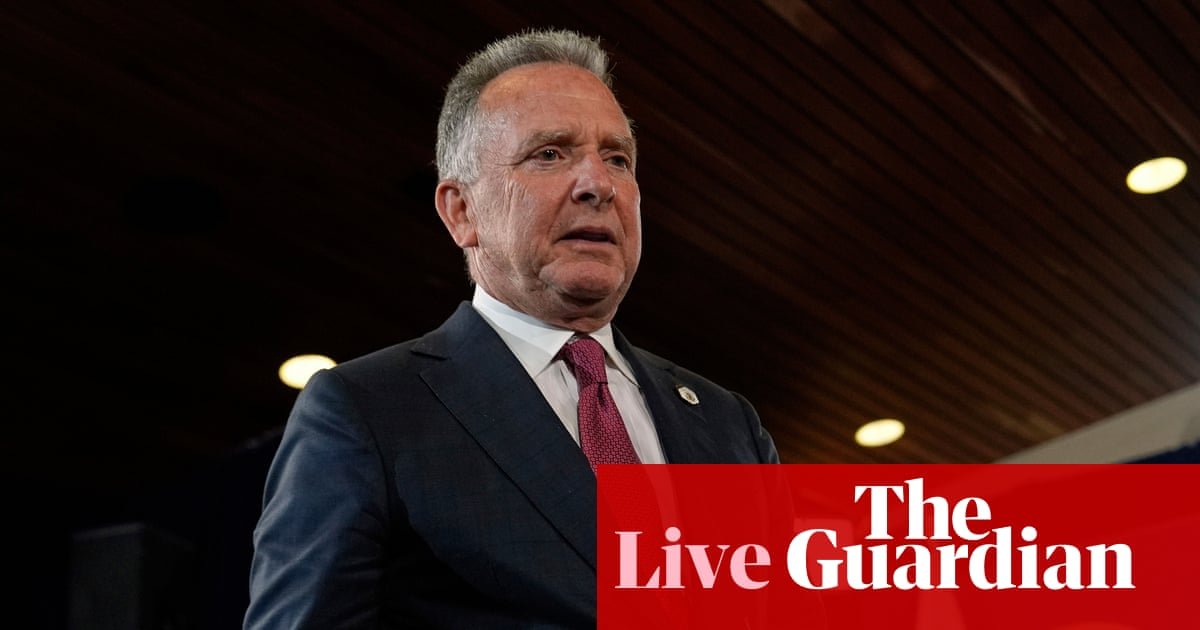
US envoy says Putin agreed to security protections for Ukraine as part of Trump summit
Special US envoy Steve Witkoff has also been speaking to the media. He said on Sunday that Vladimir Putin agreed at the Alaska summit with Donald Trump to allow the US and European allies to offer Ukraine a security guarantee resembling Nato’s collective defence mandate (article 5: an attack on one member is an attack on all) as part of an eventual deal to end the war.
Speaking with Jake Tapper, Witkoff told CNN’s State of the Union programme:
We got to an agreement that the United States and other European nations could effectively offer article five like language to cover a security guarantee. So Putin has said that a red flag is Nato admission.
And so what we were discussing was assuming that that held, assuming that the Ukrainians could agree to that, and could live with that, and everything is going to be about what the Ukrainians can live with.
But assuming they could, we were able to win the following concession: that the United States could offer article five, like protection, which is one of the real reasons why Ukraine wants to be in Nato, we sort of were able to bypass that and get an agreement that the United States could offer article five protection, which was the first time we had ever heard the Russians agree to that.
Key events
Summary
Here’s a wrap-up of the day’s key events:
-
Volodymyr Zelenskyy has released a series of statements on X after his meeting with European leaders ahead of Monday’s peace talks with Donald Trump in the US. In his statements, Zelenskyy said: “Ukraine’s constitution makes it impossible to give up or trade land. Since the territorial issue is so important, it should be discussed only by the leaders of Ukraine and Russia at the trilateral—Ukraine, the U.S., Russia. So far, Russia gives no sign this will happen, and if Russia refuses, new sanctions must follow.”
-
Ahead of Monday’s peace talks in the US, French president Emmanuel Macron said that in order to have a “lasting peace deal for Ukraine, Ukraine needs a strong army”. He added that European allies want “Ukraine’s territorial integrity to be respected” and that “Ukraine must be represented in any talks on Ukraine’s future.” Macron also said that “our goal for tomorrow’s talks is to present a united front between Ukraine and its European allies”.
-
European Union council president Antonio Costa added that he “welcomed the United States’ willingness to participate in providing security guarantees to Ukraine”. Costa said: “Transatlantic unity is paramount at this moment to achieve a sustainable peace in Ukraine.”
-
Donald Trump has published a letter Melania Trump addressed to Vladimir Putin during his visit to Alaska on Friday. In the letter, the first lady urges the Russian president to “restore the melodic laughter” of children, saying: “In protecting the innocence of these children, you will do more than serve Russia alone – you serve humanity itself. Such a bold idea transcends all human division, and you, Mr Putin, are fit to implement this vision with a stroke of the pen today.”
-
Steve Witkoff added that Russia had agreed to unspecified concessions on five Ukrainian regions central to the war, particularly the eastern Donetsk province. “We agreed to robust security guarantees that I would describe as gamechanging,” Witkoff said.
-
European leaders who are set to join Volodymyr Zelenskyy in a show of solidarity at the White House on Monday include: German chancellor Friedrich Merz, British prime minister Keir Starmer, French president Emmanuel Macron, Italian prime minister Giorgia Meloni, Finland’s president Alexander Stubb, European Commission president Ursula von der Leyen and Nato secretary-general Mark Rutte.

Peter Walker
Asked behind the scenes at June’s G7 summit if he could explain why Donald Trump seemed to like him so much, Keir Starmer admitted he did not really know. Whatever the reason, when it comes to Ukraine, the UK prime minister is once again hoping to exploit this somewhat curious relationship.
As soon as it was announced that a string of European leaders planned to join Volodymyr Zelenskyy to back the Ukrainian president in crucial talks with Trump at the White House on Monday, it was obvious Starmer would be joining them.
The idea of Britain being some sort of bridge between US and European interests is something of a longstanding UK diplomatic cliche, and not one that always necessarily carries much meaning.
But in the case of Ukraine, Starmer has very deliberately sought to position himself as a leader who can get along with Trump while consistently stressing to him Europe’s red lines over any peace plan, and trying to sweet talk the president into offering US security guarantees.
For the full analysis, click here:
Edward Helmore
In a combative series of interviews on Sunday, the US secretary of state, Marco Rubio, said that “both sides are going to have to make concessions” for there to be a peaceful resolution to the war that erupted when Russia invaded Ukraine in 2022.
“You can’t have a peace agreement unless both sides make concessions – that’s a fact,” the Trump administration’s top diplomat said Sunday on ABC’s This Week. “That’s true in virtually any negotiation. If not, it’s just called surrender. And neither side is going to surrender. So both sides are going to have to make concessions.”
Rubio said the recent talks in Alaska between Russian president Vladimir Putin and his US counterpart Donald Trump toward ending the war had “made progress in the sense that we identified potential areas of agreement – but there remains some big areas of disagreement”.
“We’re still a long ways off,” Rubio added. “We’re not at the precipice of a peace agreement. We’re not at the edge of one. But I do think progress was made and towards one.”
For the full story, click here:
Reporters from Associated Press have done a little round up of the reactions of Republican and Democrat senators to Donald Trump’s meeting with Vladimir Putin.
Among the Republicans:
-
Senator Lisa Murkowski, an Alaska Republican, wrote on social media after the summit that “while the press conference offered few details about their meeting,” she was “cautiously optimistic about the signals that some level of progress was made.” She said it “was also encouraging to hear both presidents reference future meetings” but that Ukraine “must be part of any negotiated settlement and must freely agree to its terms.”
-
Senator Lindsey Graham, a South Carolina Republican and close Trump ally, said he was “very proud” of the president for having the face-to-face meeting and was “cautiously optimistic” that the war might end “well before Christmas” if a trilateral meeting between Trump, Zelenskyy and Putin transpires.
-
Former vice-president Mike Pence commended his former boss for seeking peace. “I think he deserves credit as leader of the free world for not giving up on Ukraine,” he said on CNN’s State of the Union.
However, Democrat senators have been expressed alarm:
-
“President Trump appears to have been played yet again by Vladimir Putin,” said Democratic senator Jeanne Shaheen of New Hampshire, ranking member of the Senate foreign relations committee. “The president rolled out a red carpet and warmly greeted a murderous dictator on American soil and reports indicate he got nothing concrete in return.” She added: “If President Trump won’t act, Congress must do so decisively by passing crushing sanctions when we return in the coming weeks.”
-
Connecticut senator Chris Murphy said on NBC’s “Meet the Press” that Putin “got everything he wanted”, including a photo op with Trump. “He is intentionally murdering civilians, he’s kidnapping children, and now he got to stand next to the President of the United States — legitimized in the view of the world,” the Democrat said.
While politicians have been discussing their future, people in Ukraine have been attending a rally outside the US embassy in Kyiv. Many were women, standing with children and highlighting the plight of Ukrainian prisoners of war.
Volodymyr Zelenskyy faces a daunting trip to the White House – but this time he won’t be alone.
The Guardian’s Julian Borger writes:
Volodymyr Zelenskyy will make his second visit to the White House on Monday with the daunting task of reversing the damage done to Ukraine’s security prospects by Friday’s Trump-Putin summit in Alaska.
Zelenskyy will not, however, be alone as he was on his first trip to the White House in February when he was ambushed and humiliated by Donald Trump and the vice-president, JD Vance, who sought to bully him into capitulation to Moscow’s demands.
This time the Ukrainian leader comes to Washington flanked by a dream team of European leaders, including Britain’s Keir Starmer, Germany’s Friedrich Merz and France’s Emmanuel Macron, who combine economic and military clout with proven rapport with Trump.
Their mission will be to try to use their individual and combined influence to coax the president out of the pro-Russian positions he adopted after just a couple of hours under Putin’s sway in the sub-Arctic on Friday.
To do that, they will have to project a more convincing sense of resolve and common purpose than they have managed hitherto, argued Ben Rhodes, a former adviser to Barack Obama.
For the full analysis, click here:
Zelenskyy: ‘Ukraine’s constitution makes it impossible to give up or trade land’
Volodymyr Zelenskyy has released a series of statements on X after his meeting with European leaders ahead of Monday’s peace talks with Donald Trump in the US.
In his statements, Zelenskyy said:
We have to stop the killings. Putin has many demands but we do not know all of them. If there are really as many as we heard, then it will take time to go through them all. It is impossible to do this under the pressure of weapons …
We need real negotiations, which means they can start where the front line is now. The contact line is the best line for talking. Europeans support this, and we thank everyone. Russia is still unsuccessful in the Donetsk region, Putin has been unable to take it for 12 years …
Ukraine’s Constitution makes it impossible to give up or trade land. Since the territorial issue is so important, it should be discussed only by the leaders of Ukraine and Russia at the trilateral—Ukraine, the U.S., Russia. So far, Russia gives no sign this will happen, and if Russia refuses, new sanctions must follow.
It’s important that America agrees to work with Europe to provide security guarantees for Ukraine, and therefore for all of Europe. This is a significant change, but there are no details how it will work—what America’s role will be, what Europe’s role will be, what the EU can do. We need security to work in practice, like Article 5 of NATO.”
A string of Ukrainian politicians and public figures condemned the idea of handing over unoccupied land to Russia for peace on Sunday, arguing that their country had not been defeated and should not be forced into a surrender.
The Guardian’s Dan Sabbagh and Artem Mazhulin report:
The hardening of the mood comes at the end of a weekend where there was first ridicule and disgust in Ukraine at the red carpet treatment of Vladimir Putin by Donald Trump at their summit in Alaska – followed by frustration as it appeared that Trump was siding with the Russian leader.
Trump reportedly told European leaders that he believed a peace deal could be negotiated if Volodymyr Zelenskyy agreed to give up the areas of the Donbas region that the Russian invaders have not been able to seize in more than three years of fighting.
Halyna Yanchenko, an independent member of Ukraine’s parliament, said demands that Ukraine “simply surrender new territories without a fight – just because Putin wants it – is absurd from the very start”.
The MP, an anti-corruption activist previously part of Zelenskyy’s Servant of the People party, said that hundreds of thousands of Ukrainians would be affected by Putin’s proposal, initially favoured by Trump after Friday’s Alaska summit.
For the full story, click here:
Emmanuel Macron further said: “No country can accept the loss of territories unless it has security guarantees for its remaining territory.”
The French president added: “If we are weak today, we will pay a heavy price tomorrow … If Europe wants to be free and independent, we need to be feared and we need to be strong.”
Emmanuel Macron: Goal for tomorrow’s talks is to ‘present united front’ between Ukraine and European allies
Ahead of Monday’s peace talks in the US, French president Emmanuel Macron said that in order to have a “lasting peace deal for Ukraine, Ukraine needs a strong army”.
He added that European allies want “Ukraine’s territorial integrity to be respected” and that “Ukraine must be represented in any talks on Ukraine’s future.”
Macron also said that “our goal for tomorrow’s talks is to present a united front between Ukraine and its European allies.”
He went on to warn that “if we show weakness today in front of Russia, we are laying the ground for future conflict.”
EU council president: ‘If no ceasefire is agreed, the EU and US must increase pressure on Russia’
European Union council president Antonio Costa added that he “welcomed the United States’ willingness to participate in providing security guarantees to Ukraine”.
Costa said: “Transatlantic unity is paramount at this moment to achieve a sustainable peace in Ukraine.”
He added: “As I underlined during today’s meeting of the Coalition of the Willing, if no ceasefire is agreed, the EU and the US must increase pressure on Russia.”
Following the ‘Coalition of the Willing’ meeting among European countries ahead of Monday’s peace talks in Washington DC, European leaders are releasing statements regarding Ukraine.
An European Union Commission spokesperson said that the “videoconference of Ukraine’s allies focused on key matters such as the need to stop the killing in Ukraine, the commitment to maintain full pressure against Russia via sanctions.”
The spokesperson added that the “leaders involved in the video conference of Ukraine’s allies reaffirmed their unity in supporting Ukraine towards a just and lasting peace.”