


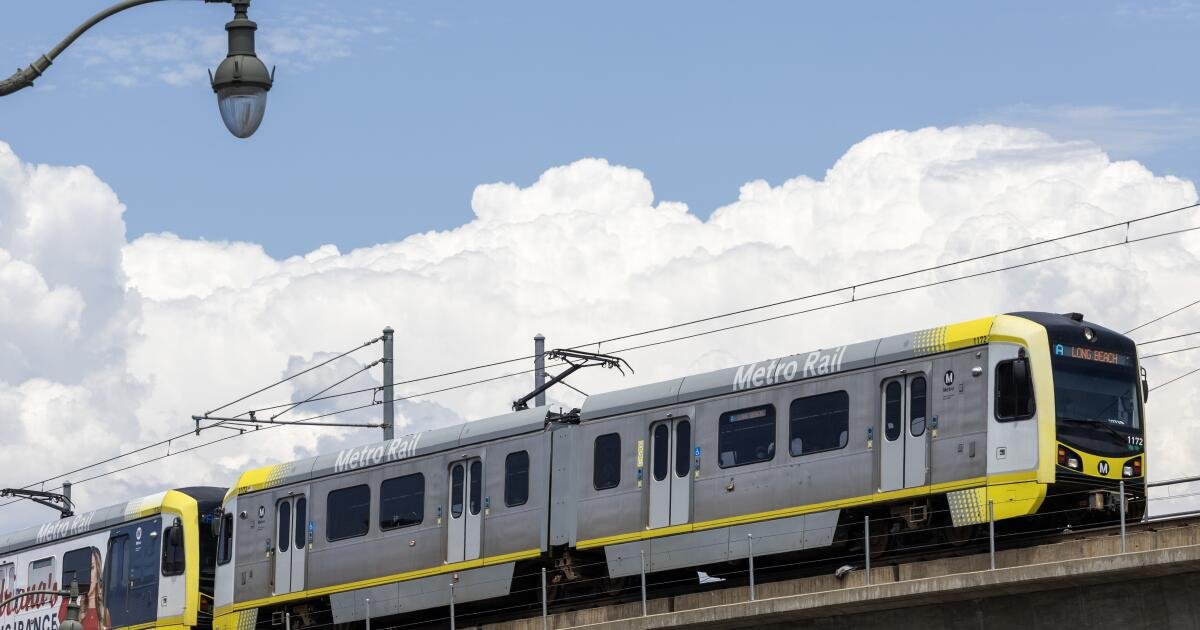
We’re a state of “Big Dreams,” as author Bill Barich once chronicled in his tour of California from top to bottom. But in our biggest city, dreams of a car-free Olympics are poised to remain just that: dreams. Only about a third of Metro’s “28 Projects by ‘28 Games” transit proposals are complete, even after a reshuffle of plans to be more realistic.
Meanwhile, the city is being sued by a concerned transit blogger for failing to implement Measure HLA, which commits it to executing its “Mobility Plan 2035,” including new bike lanes, bus lanes and pedestrian improvements. And rust will soon surface on the big dreams of high-speed rail between L.A. and San Francisco, with its funds rescinded by the Trump administration almost understandably after 15 years of work with precious little to show. When it comes to transit, climate hawks and urbanists get the message: Keep dreaming.
For the record:
10:45 a.m. Oct. 1, 2025An earlier version of this article incorrectly stated that a station along the D Line extension to Westwood was completed by the city while Wilshire Blvd. was shut for two weeks in 2020. Only foundational work on that station (Wilshire / Rodeo Station in Beverly Hills) was completed; it was conducted by L.A. Metro and took 11 weeks.
L.A.’s lack of progress isn’t for lack of effort. As we prepare to host the world yet again, the city is conducting the largest public transit buildout in the U.S. by far, financed by twin ballot measures (Measures M and R) that provide ample resources and at least some direction. LA Metro has staffed up accordingly, with an increasingly large and competent team and plans to bring more functions in-house and under its direct control.
We have, for our trouble, notched some wins recently: A Regional Connector project now unifies the A and E line with the L line downtown (if three years behind schedule), and a new L Line stop has opened in Pomona this month (though that extension was shortened and delayed). LAX now has a nearby Metro station that will help provide connectivity to SoFi Stadium during the Olympics and Paralympics.
That’s the good news. Unsurprisingly, any close accounting of Measures M and R nets out in the red; for each success story, there seem to be infinitely more stories of delay, cost overrun and failure. A list of stalled Olympics projects includes an extension of the D line to Westwood and its athletic facilities, and further delay of LAX’s people-mover project, which actually connects the airport to its station and thereby SoFi. While less related to the Olympics, “28 by ‘28” plans for the Bus Rapid Transit Line down bustling Vermont Avenue and between North Hollywood and Pasadena have also experienced considerable delay.
Why does transit fail in L.A.? Many blame our size, but we only cover the same land mass as well-connected Tokyo. Size can’t explain the high cost per station and cost per mile of our transit projects. Even among transit practitioners, ask 100 people what the problem is and you will get 100 different answers.
That’s not to say you’ll get 100 completely different answers, as at least three challenges will recur — for one, the threat of lawsuit. The onerous review mandated by the California Environmental Quality Act provides ample surface area for suits. In the decades since its introduction, CEQA has ironically and cynically developed from a basic set of safeguards into an all-purpose weapon against infill housing, clean energy and transit projects. Thankfully, it is increasingly subject to revision in Sacramento.
The second reason is unnecessary regulatory complexity. Important topics like procurement and fire safety have accrued long and byzantine codes that force costs up considerably without actually improving outcomes. And if your project touches different cities within the county, though they may have literally 99.5% identical permitting applications, you will nonetheless need to file distinctly with each of them for project approval.
The third and perhaps most stubborn reason is overlapping jurisdiction. Take a common example: When abandoned utility infrastructure is discovered during digging, construction grinds to a halt until a safe relocation can be conducted. Utilities have no obligation and thus no urgency to clean up after themselves; they may even ask to trade any cleanup for unrelated upgrades. These incentives issues apply to cities as well. And even within L.A. proper, jurisdictional overlap between the city and Metro, despite the two sharing an MOU meant to resolve it, has produced stasis on Vermont’s Bus Rapid Transit project, raising the aforementioned legal questions about the city’s compliance with HLA.
I’ll keep dreaming big dreams of something better. Remember that D Line extension to Westwood? In 2020, Metro actually completed foundational work on its upcoming Wilshire / Rodeo station in Beverly Hills ahead of schedule. Where Metro once planned to do alternating, partial closures on Wilshire for 11 months, it changed plans amid a drop in traffic during COVID. With Beverly Hills’ permission, the street was completely closed instead, allowing Metro to work 24/7 and complete the construction in just 11 weeks. Without that shift, our ambition to reach Westwood by 2028 would be even less credible today.
That success tells us how to serve Angelenos, let alone the world: Let Metro cook. Empowering the agency — with its ever-increasing competence, guaranteed funding stream, mandate straight from voters, and accountability to a board of electeds — would be a smart way to resolve stasis and reduce regulatory headwinds.
Sure, a reform package from the state or county should generally obligate Metro by default to follow each city’s permitting standards and to make good-faith efforts to modify projects at the request of cities. But it should formalize an expectation that cities, in turn, move quickly and put up funds or match funds to the best of their ability (perhaps drawing on their own allocations under Measures M and R). Metro should also be allowed to judge when those standards and modifications are sufficiently specific, objective and cost-effective.
Finally, Metro should be entitled to expanded control of key rights-of-way, which may occasionally mean shutting down a street even without the extenuating circumstance of a pandemic. This type of strengthened authority would move us more in line with the international model of success demonstrated in Europe and Asia. Our worldwide visitors will be deeply familiar with the principle: To build a city that works, someone needs to be in charge.
Joshua Seawell is the head of policy at the Inclusive Abundance Initiative and lives in Los Feliz.